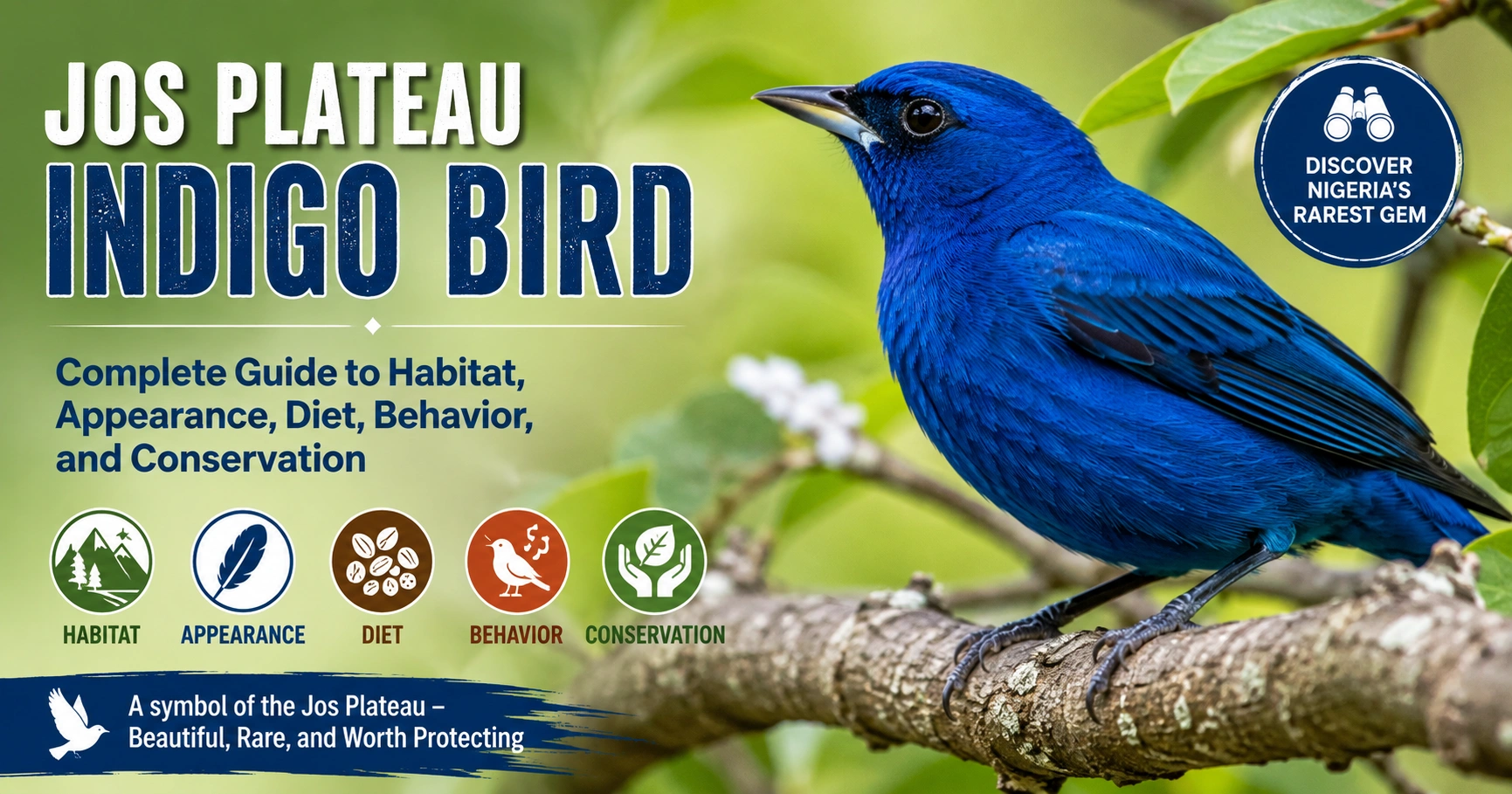
Jos Plateau Indigo Bird Description
The Jos Plateau indigo bird, scientifically known as Vidua maryae, is one of Africa’s specialty small passerine birds. This bird is so numerous that you could easily mistake it for just another dull finch-sized bird running about among the dry grasslands, rocky grasslands, and stunted trees of the Jos Plateau. But a second look shows the fascinating ecological relationships that make the bird really special. The Jos Plateau indigo bird belongs to the family Viduidae, whose members are associated with a strange form of symbiosis.
It requires nestling in the nests of its hosts and laying eggs there. The latest I know of a host for the Jos Plateau indigo bird is the Rock Fire finch (Lagonosticta sanguinodorsalis). Vidua maryae does not build its own nest, and its young are not attended to. Rather, the female indigo lays her eggs in the nests of the selected host, and the indigo bird chicks are incubated and fed as if they were the host’s own offspring. Current specialists note that the Jos Plateau indigo bird is an inhabitant of northern Nigeria and, according to recent finds, northern Cameroon.
It is noteworthy that the study of this species is directly related to the understanding of two main features distinguishing the Vidua maryae from other birds. The first is the peculiarities of the plumage, due to which the indigo bird gets its name. The second is the ability of the male Jos Plateau indigo bird to imitate the song of its host. Thanks to this feature, it becomes possible to determine the species by its voice.
According to the Boston University Indigobirds Project, the Jos Plateau indigo bird has green feathers and a white bill. Moreover, the legs of this bird are light purple, and the wings are brown. The researchers describe this species as closely associated with the Rock Firefinch and noted that the Jos Plateau indigo bird imitates the firefinch’s descending trill and whistles. Hence, the uniqueness of the Jos Plateau indigo bird lies in the fact that the study of this representative of the Viduidae family provides insight into the study of one ecological relationship.
Taxonomic Classification and Related Information
The indigobird, Vidua maryae, was described by Robert Payne in 1982 in this scientific name. This species is now treated as a full species, and the Birds of the World, which contains the most comprehensive authoritative taxonomic information on all species of birds, considers it monotypic. Vidua maryae falls under the order Passeriformes – most perching birds that possess special adaptations for walking on the ground and the Viduidae family, which consists of indigobirds and whydahs. Interestingly, some species of this family are obligate parasites that lay their eggs in the nests of the estrildid finches.
Jos Plateau Indigo Bird’s classification is an intriguing example of taxonomy’s importance. Moreover, it demonstrates how essential extensive field studies are to understanding how different species of birds are related. According to Birds of the World, this particular indigo bird was discovered in 1968 and first found near Panshanu Pass in Nigeria, making it a ‘new’ species of indigo bird since it had been mistaken for the Dusky Indigobird ( V. funerea ). The confusion with the Dusky Indigobird was partly because it had been associated with the African Firefinch and assumed to be its host.
But subsequent studies revealed that the African Firefinch itself was a distinct species and not a subspecies of the Rock Firefinch. This is a classic illustration of why taxonomy matters. As the two birds were similar in appearance, the majority of people would not have noticed their differences without a lot of studying. Hence, to investigate African crested birds, one needs to look no further than the taxonomic relationships among species, to be partially obscured by the fact that such birds frequently parasitize the nests of various estrildid finches.
What Does the Jos Plateau Indigo Bird Look Like?
The Jos Plateau Indigo Bird’s appearance varies depending on sex and the season, which makes it particularly challenging to identify. According to National Geographic, breeding males have a glossy green to blue-green color and brown flight feathers, a whitish bill, and pale purplish legs. Their female counterparts and nonbreeding males are brownish on the upperparts and paler on the underparts. Birds of the World likens it to the Jambandu Indigobird and the Barka Indigobird. This is why they can be mistaken for one another, as they look alike, although their songs are different.
I think this is interesting information, as I can’t tell them apart when shown photos of different birds. For example, if someone showed me two similar books, I wouldn’t be able to tell them apart before reading the titles. The same applies to birds, except that the title is represented by their song. According to the Boston University Independent Research Project on Indigobirds, the color of the plumage, legs, and the bill can vary depending on the environment, making the bird’s appearance deceptive.
Also, when these birds feed on the ground, the color can appear differently because of staining, so the project advises looking at the host’s song. So, if I were out birding and saw a greenish bird, I certainly wouldn’t immediately think, “That’s a Jos Plateau Indigo Bulbul!” First, I would need to make certain that the bird was indeed at the location where it had been seen, and then I would have to identify it by the song it was uttering.
Dimensions, Weight & Features of the Body
The Jos Indigo Bunting is a tiny passerine bird and is said to be eleven centimetres long, according to one source. An adult Jos Plateau Indigo Bunting weighs approximately 12-13 g, as per the same source, which makes this bird incredibly light. A tiny animal like that could zigzag unpredictably among grasses, and chasing its movements is difficult, especially on stones where one must just see or hear the bird. Small size is also a significant part of the challenge when photographing the Jos Plateau Indigo Bird and recording its calls.
However, the bird’s size is not the only characteristic that contributes to its challenge in identification. The combination of a green or blue-green head, brown wings, a white bill, and pale purplish legs makes the Jos Plateau Indigo bird recognizable, at least theoretically. However, quite a few factors can cause the color of a bird’s feathers to be perceived differently. In particular, natural light (clouds), distance between the subject and observer, and dust in the atmosphere may influence the perceived color of the feathers.
So it is not advisable to try to name a bird based on one feature, even if it is normally unique for this species. Instead, a birder should use the information about the bird’s distribution, ecology, and behavior to accompany the observations of coloration. Therefore, the Jos Plateau Indigo Bird is a perfect example of such a bird in that you have to combine several pieces of information to identify it. In fact, in a way, identifying these birds is like solving a puzzle – a few pieces may be missing, but the majority of them are there, and that makes the job doable.
Where Does the Jos Plateau Indigo Bird Live?
The species is named after the Jos Plateau region of Nigeria, which is its likely endemic area. According to current sources, the avian species’ distribution extends “from northern Nigeria into northern Cameroon,” whereas previous accounts suggested a range restricted to Nigeria only. Birds of the World considers it a small-ranged bird, found “in northern Nigeria and Cameroon,” with sightings reported from the cities Maroua and Mora in Cameroon. It is notable that the distributions of species are not fixed and may be updated as new information becomes available.
It is postulated that the Jos Plateau Indigo Bird inhabits rocky habitats and dry savanna rather than the tropical rainforests that characterize the region. The bird’s distribution is also limited to areas of rocky country, dry woodlands, and shrublands or savanna. It is also suggested that the Jos Plateau Indigo Bird is non-migratory. Thus, it can be concluded that the Jos Plateau Indigo Bird’s distribution is limited to Nigeria and Cameroon. Surprisingly, conservation efforts for one species can help the conservation efforts of another species, such as the Jos Plateau Indigo Bird and the Rock Firefinch. The similarities in their habitats indicate that conservation efforts can have a positive effect on both species.
Jos Plateau Habitat and Elevation
Jos Plateau is a region that offers a unique habitat for the country’s diverse bird species. Its connection with the Indigo Bird explains why this place attracts ornithologists. According to Birds of the World, the Jos Plateau Indigo Bird and its host, the Rock Firefinch, “inhabit rocky outcrops and inselbergs of semi-arid Guinean savanna” (“Jos Plateau Indigo-cuckoo” par. 5). This result may vary in different parts of the world. The area consists of a combination of open vegetation and rock surfaces with bushes, grasslands, and the occasional tree. Such a terrain is deemed to be very sparse, but even so, it supports novel wildlife.
The rocky outcrops of Jos Plateau provide the Indigo Bird with host nests, perches, predator protection, and a source of grass seeds. At the same time, this ecosystem is fragile because human activities can lead to the complete removal of vegetation for agricultural activities, grazing, fuel, roads, and settlements. Thus, the effect on the local environment can be particularly harsh for species with a range-restricted distribution. Here, extirpation of the Rock Firefinch can translate into the decline of the Jos Plateau Indigo-cuckoo. This fact suggests that the habitat of these birds needs to be considered as the foundation of the regional ecosystem. If it is damaged, several interrelated populations will be at risk.
Diet and feeding behaviour
Jos Plateau indigobird is a brood-parasitic species for which conspecific breeding biology is better understood, but it is still closely restricted to seed–dispersing habitats; its foraging regime ties it. Because of its small size and the fact that it is granivorous (eats seeds), the bird feeds in shaded areas under tall grass on low plants. The problem is that they are fairly quick to go into hiding when approached, so one (indigobird) can be a real challenge to get a distance.
This is especially so when the bird is not breeding, as they have a less striking plumage, which blends with the grass. The Boston University team of researchers points to another challenge; that is, that they are ground feeders, so the coloration of their legs and bill could be hidden, as well, by the dirt.
Beyond the obvious benefit of providing food, the feeding behavior of these little birds has another benefit for the local ecosystem. Seed-eating passerines such as the Jos Plateau Indigo Bird play a crucial role in the food web, influencing the local insect population and being a part of the system of grasslands, trees, larger birds, and animals. After all, one single daily activity of a small passerine such as this can create a ripple effect throughout the local ecosystem, as it is a part of it. For this species, its feeding ecology cannot be separated from the issue of habitat.
The maintenance of an appropriate balance will require careful consideration of the ecology of the Jos Plateau. The area cannot be overly exploited (burned), turned into agricultural fields, or used for grazing, as the grasses will begin to disappear, taking part of the food away from the Indigo Bird. This, in turn, will affect the Rock Firefinch as well, as it depends on the bird’s ecology.
The Rock Firefinch Connection
Probably the most surprising, or interesting, thing about the Jos Plateau indigo bird is its close relationship to the Rock Firefinch (Lagonosticta sanguinodorsalis). The reason is that the Rock Firefinch is the host to the Indigo Bird’s brood parasitism. In nature, this bird does not nest for its young. It has adapted to become completely reliant on another species that it would have inevitably perished without. The host of the Jos Plateau Indigo Bird is the Rock Firefinch, according to Birds of the World. The same source is noted in the AU database of Boston University.
It is an interesting fact that connects these two species. Of course, there is no literal agreement between the birds on the terms of their coexistence, but there is something similar to it. The Indigo Bird lays eggs in the nests of the Rock Firefinch, which means that it avoids all the inconveniences and responsibilities of raising offspring. However, the host undertakes all the difficulties of parenting. The relationship between these species is regarded as an instance of parasitism. However, these kinds of relations can be between two individuals only if both benefit.
The Rock Firefinch, as the host, gets the chance to adapt with specialized mechanisms against parasitism. Meanwhile, the Jos Plateau Indigo Bird, as a parasite, can be compelled to change some of its habits to avoid suspicion. Therefore, the study of this relationship is invaluable for understanding the processes of evolution that have taken place in this particular area. In addition, studying the life habits of the Jos Plateau Indigo Bird without understanding its connection with the Rock Firefinch would fail to reflect one key aspect of this type of bird.
How Brood Parasitism Works
Brood parasitism ranks among the most astonishing reproductive strategies of the animal kingdom. Instead of raising its own young, the parasite lays eggs in the nest of a different species, and that other bird’s parents end up doing the labor and providing the resources. This strategy is beneficial for the parasitic species because it allows them to redirect a significant part of the energetic investment into other areas while relying on the host’s efforts and care. In the case of the Jos Plateau Indigo Bird, its favored host is the Rock Firefinch.
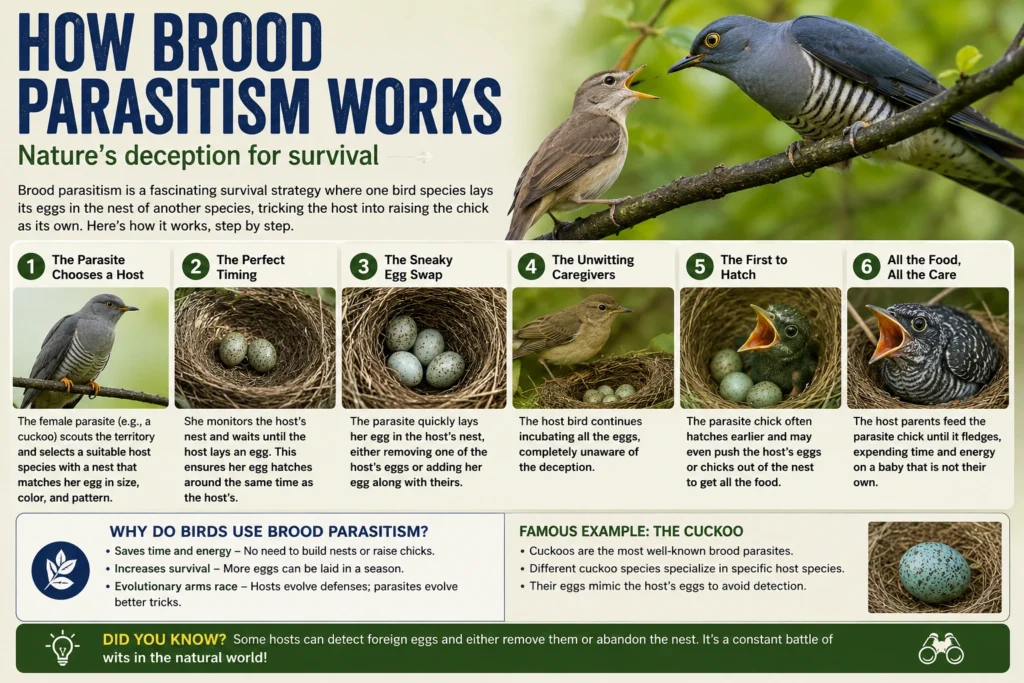
The evolutionary relevance of parasitism as a strategy is evident based on the high level of competition both species face. For instance, the text states that the Indigo Bird removes as many eggs from the host’s nest as the ones it intends to lay to avoid suspicion. After hatching, the parasite’s young have to compete with the Rock Firefinch’s chicks for resources.
The evolutionary history of parasitism is characterized by an intricate arms race between the host and the parasite. But the parasite also needs to evolve in this host arms race to overcome the host defences and provide its young with an adequate share of care and resources. Consequently, brood parasitism presents a captivating research subject for evolutionary biologists aiming to unravel the intricate processes underlying adaptation and natural selection.
Vocal Mimicry and Song Learning
The Jos Plateau Indigo Bird’s vocal behavior may be even more important for identification than its plumage. Male indigobirds learn to imitate the songs of their host species, and the Jos Plateau Indigo Bird is associated with vocal mimicry of the Rock Firefinch. The Boston University species account describes mimicry of the firefinch’s descending trill, represented as “treeeee,” along with various whistles. This is not merely a pleasant musical resemblance. The song plays a role in the bird’s social and reproductive biology.
Vocal learning creates a fascinating chain of information across generations. A young male must acquire the appropriate vocal patterns, and those sounds can help communicate its identity and reproductive association. Birds of the World, for example, states that ‘this species can be identified in the field by host-song mimicry.’ Consider the song as a sort of acoustic fingerprint.
Two indigobirds may appear superficially similar enough to deceive the eye, but their host songs can provide an even stronger hint as to their identity. This is why modern bird research increasingly combines visual observation with audio recording. A high-quality recording can preserve information that a photograph cannot, allowing researchers to compare vocal patterns and improve knowledge of species distribution.
Breeding season and reproductive behavior
The breeding biology of the Jos Plateau Indigo Bird is inseparable from that of its host. The available sightings suggest that breeding occurs throughout the year, with a peak during the cool, dry Harmattan period of July–December. The reproductive success of the parasitic Indigo Bird is inextricably linked to the biology of its host; thus, changes in the host’s nesting behavior due to fluctuations in rainfall, food abundance, human disturbances, or other environmental variables will inevitably affect the parasite’s reproductive success.
I think it is interesting to consider how the biology of a specialist parasite is linked to several different factors in turn, which relate to the abundance and distribution of its hosts. If an ecosystem can sustain a certain level of generalist species, it can also sustain several specialist parasites. The Jos Plateau Indigo Bird’s reproductive strategy appears to be one of the most successful, but its very success relies on a confluence of favorable conditions.
Those studying this kind of parasite need to bear in mind that the sighting of a single bird is just one facet of a multifaceted problem. You have to look at the big picture: the host and the environment. This approach is the only way to fully understand how and why the number of Indigo Birds changes. Perhaps a decrease in their numbers is related to the destruction of habitats or a decrease in the number of potential hosts or something entirely unrelated. Only multifactorial research will provide the necessary information for combating the decline in numbers.
Behavior and Daily Life
Like many small passerines, the Jos Plateau indigobird is presumed to have a double life: foraging and evading predators and breeding and raising young. The plumage is dull and enables them to blend into dry bush or rocky ground where they are more often encountered. But in the breeding season the indigobird is a bit more conspicuous.
Perhaps its behavioral pattern is even more noteworthy, though. The bird is capable of learning and imitating sounds, thus providing researchers with more clues about their presence. Since the Jos Plateau indigobird is most likely not a migrant but rather a resident inhabitant of rocky plateaus, individuals of this species have sufficient time to study the behaviors specific to their habitat.
It would appear that behavioral observations are even more crucial for an indigobird than plumage or any other visual cues. In this regard, perhaps, the art of birdwatching can be seen as a kind of detective activity where every move counts. Detectives specializing in solving ornithological mysteries should have profound knowledge of birds’ behavior.
This expertise is critical when it comes to the indigobird because the available knowledge about this species is limited to what has been managed to obtain through observations. Thus, there would be more facts about the Jos Plateau indigobird’s distribution, breeding strategies, abundance, and other features if more people devoted attention to studying these fascinating creatures.
Conservation Status and Main Threats
In the specialist literature at present time, the Jos Plateau Indigo Bird is classified as Least Concern on the IUCN Red List. For Birds of the World, the same category is also given, while BirdLife International provides a unique page for the species Vidua maryae. The category Least Concern does not mean that the species is entirely secure and faces no threats. Meanwhile, the given classification might be explained by the fact that the bird’s distribution is limited to a relatively small area, while the IUCN Red List category evaluation process follows specific global criteria.
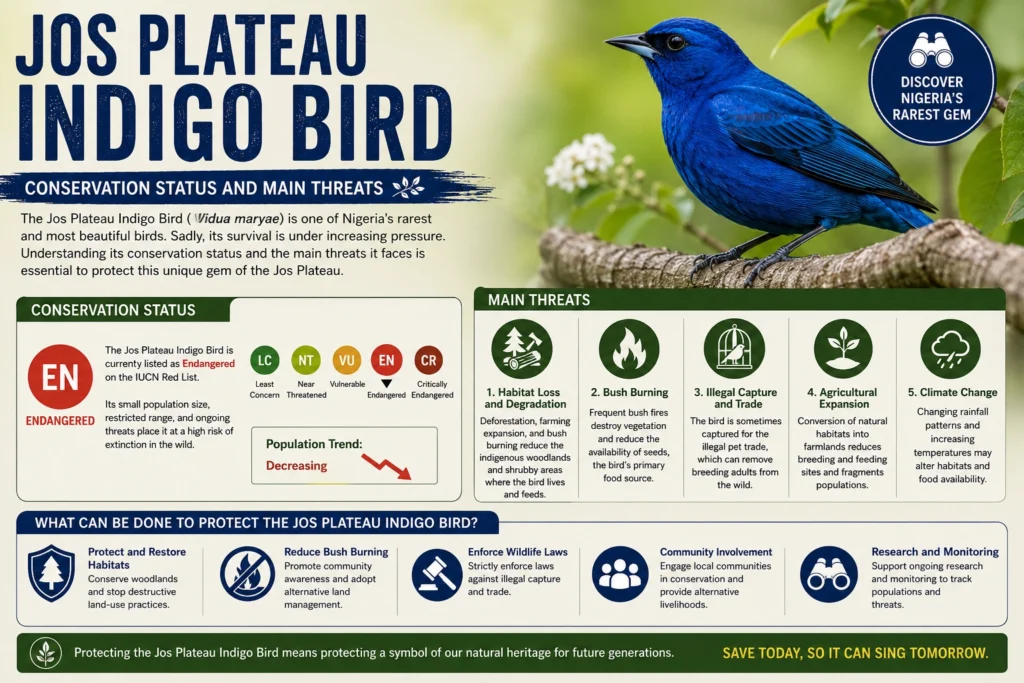
Its greatest threat is habitat destruction as a result of human interference. Consequently, the drywoodland, shrubland, and savanna biomes in which the species occurs are under threat from farming, cattle ranching, logging, and other human activities. According to Birds of the World, precisely the conversion of habitats due to agriculture, grazing, and woodcutting contributes to the species’ endangerment. Meanwhile, the species’ extreme dependence on its host makes it more vulnerable than one might expect at first glance. Thus, it is not enough to have some green areas within a local region – they need to provide a suitable microhabitat for the individual species of the Rock Firefinch.
Why the Species Matters to Biodiversity
Each species plays an important role in the context of the ecosystem it inhabits, but the Jos Plateau Indigo Bird, in my opinion, is a great example of biodiversity due to its uniqueness. First of all, this animal species has developed a unique connection with another species, the Rock Firefinch, its environment, and its own specializations, such as the ability to imitate other birds’ calls.
The study of this species can provide valuable information about the evolutionary mechanisms of biological reproduction and adaptation. Secondly, I think this is a good demonstration of the general nature of biogeography being tied so tightly to nature. In addition, the Jos Plateau Indigo Bird can be raised as an ecosystem ambassador species in which it is found.
Usually, people tend to back proposals for the conservation of big animals, carnivores, or birds that appear pretty or unique to them. But there are numerous other creatures, such as the Jos Plateau Indigo Bird, which play a vital role in their habitats. Thus, if people are motivated to preserve the local ecosystem, the microhabitat, and the resources of the savanna and woodland that this bird species occupies, they will be able to help a variety of animals and plants.
The local community, field researchers, birdwatchers, and conservationists will then have work opportunities and will be able to take advantage of existing resources to draw attention to the problem. And so, in my opinion, the value of the Jos Plateau Indigo Bird is the intricate mechanisms that can be hidden even in a small bird, such as this type of indigo.
How Birdwatchers Can Identify It
A birder must be cautious and patient enough to have a good view to find a Jos Plateau Indigo Bird. An adult or male has glossy green or blue-green feathers, brown flight feathers, a white bill, and pale purple legs. But the Jos Plateau Indigo Birds are not easy to identify, as a few more closely related indigobird species look similar to them and also live in the region. In addition to the described physical traits, the Boston University Indigobirds Project recommends focusing on the host-song mimicry. According to Birds of the World, vocal mimicry is also an essential identification feature.
Therefore, the most practical approach to identifying the Jos Plateau Indigo Bird would be to document the location and describe the general appearance and behavior of the observed bird. Moreover, if possible, a birder should record any calls or songs. A call can allow us to pinpoint the presence of an indigobird hidden from view. In addition, it is very important not to disturb the nests and the birds so as not to alter their behaviours.
To see such a specialised and rare bird in the wild is amazing enough, but to actually watch it working in the wild is quite exciting. Therefore, an ethical birder should leave the natural world as they find it. Finally, photographs, audio recordings, and precise GPS locations for future research would be helpful for someone who has seen the Jos Plateau Indigo Bird. One should also note the time of the year and the surrounding habitat type, as well as any Rock Firefinches that may have been observed.
Research and Knowledge Gaps
The Jos Plateau indigobird has been described to science for many years, yet there remain important gaps in our knowledge about this species. As stated in‘Birds of the World,’ there is a paucity of observations and photographic documentation on eBird in this species account, indicating that further study is warranted. Knowledge on population size, distribution, breeding success, host interactions, and habitat is required. Host interactions and habitat. This is crucial for developing proper conservation efforts.
Modern technology can play an essential role in this process, allowing scientists to gather and organize much more data. For instance, automated recorders can help monitor the species’ soundscape continuously, while community scientists can report sightings to establish distribution patterns. Besides, the use of photography and nest watching can provide essential information on the host-parasite relationships, which do not require the constant presence of researchers.
Finally, satellite imagery can be used to track the changes in natural habitats and urban development in the Jos Plateau region. These methods may be combined, since the study of an ecological niche is best approached from several angles. A parasite that relies on a single species for survival cannot be fully appreciated by looking at one site or one species. Conservation Actions That Can Help
Conservation of the Jos Plateau Indigo Bunting will most probably require the restoration and maintenance of the bird’s habitat. Continuity of rocky, savanna, dry woodland, shrubland, and grassland habitats that host the Jos Plateau Indigo Bunting and Rock Firefinch is very important to maintain. The destruction of landscapes and ecosystems through overgrazing, unsustainable extraction of wood, agricultural practices, and other processes that threaten to destroy natural habitats and promote the desiccation of ecosystems also must be taken into account. Considering its presumed restricted distribution, the conservation of suitable habitats has to be prioritized for the Jos Plateau Indigo Bunting.
It is vital to conduct comprehensive research and monitor the species to gain insight into its behavior patterns and the key areas of its distribution. The conservation of such a rare bird species is only possible if the scientists’ activity is combined with local action. Deforestation and land degradation threaten the Bala redbelly toad, and thus local people need to be engaged in conservation efforts to facilitate long-term protection of vital habitats within the area. Hence, it is necessary to arrange training for birdwatchers and keep in touch with local authorities.
Moreover, birdwatchers may provide valuable data regarding the distribution of the Jos Plateau Indigo Bird and participate in compiling such information in reputable databases. However, bird watching should not be encouraged as a means of bringing tourism revenue into the area. What is important is to make known the need for conservation of the Jos Plateau Indigo Bird. Seiler suggests this can be achieved through conservation measures related to habitat conservation, scientific research, community participation, and ethical birdwatching, which may also help sustain the area’s development.
External Link
• BirdLife International — Jos Plateau Indigobird species factsheet
• Cornell Birds of the World — Jos Plateau Indigobird
• Boston University Indigobirds Project — Jos Plateau Indigobird
• Avibase — ‘ Vidua maryae’ taxonomy and distribution resources
Internal link
Learn more about the Jos Plateau Indigo Bird, including its habitat, appearance, diet, breeding behavior, Rock Firefinch relationship, and conservation status.
Conclusion
The Jos Plateau indigo bird has a complex and fascinating bio-ecology that makes it one of the most extraordinary small passerine birds. This species is restricted to a relatively small area in Africa. Furthermore, the Jos Plateau indigo bird exhibits obligate mutualism with the rock firefinch, is parasitic, and has remarkable mimicking abilities. In general, the bird appears to be much more diverse and sophisticated than its habitat suggests. Although the IUCN has classified the Jos Plateau indigo bird as Least Concern, there is still limited information about this species’ ecology. Consequently, additional research and continuous monitoring of the population size are needed to ensure that humans do not interfere with the species’ survival.
Nevertheless, the most valuable aspect of studying the Jos Plateau indigo bird and other endangered species is that conservation efforts should be made to preserve entire ecosystems, not just individual animals. In particular, conserving the Jos Plateau indigo bird will result in the indirect preservation of the forest-dwelling and savanna-inhabiting host species, as well as the local vegetation and topography. Subsequently, these relationships and environments must be maintained by both the population and the government. Further research, ornithological and conservation work, will yield better results and provide more knowledge regarding the ecology of the Jos Plateau indigo bird. Ultimately, the bird has an extraordinary story to tell about the biogeography of Africa.
Frequently Asked Questions about Jos Plateau Indigo Bird
1. What is the scientific name of the Jos indigo?
The Jos Plateau Indigo Bird is monotypic and is scientifically named Vidua maryae. It is from the family Viduidae and the genus Vidua. Its taxonomic status according to the present taxonomic treatments is that of a monotypic species.
2. Where does the Jos Plateau Indigo Bird live?
The Jos Plateau Indigo Bird occurs only in Nigeria, in the northern Jos Plateau. Recent specialist opinion has it that the Jos Plateau Indigo Bird also occurs in northern Cameroon.
3. What bird does the Jos Plateau Indigo Bird parasitize?
The host of this bird species is the Rock Firefinch ( Lagonosticta sanguinodorsalis ). The parasitic relationship of the Jos Plateau Indigo Bird with the Rock Firefinch is the main characteristic of this species.
4. Is the Jos Plateau Indigo Bunting threatened?
The Jos Plateau Indigo Bunting Current population Trend: stable. Conservation status – The conservation status is Least Concern (LC) at the moment. There is still a threat to this species from agriculture, hunting, grazing, and collection of firewood. Because of this, it is still considered locally endangered as it has a very limited distribution and a particular host.
5. How can you identify a Jos Plateau Indigo Bird?
A male breeding Indigo Bird is blue-green in colour with brown wings, a pale bill and pale purple legs. But since a few other indigo birds are also confused with the Jos Plateau Indigo Bird, the best way to distinguish them is by their calls, such as the Rock Firefinch’s calls.