Description:
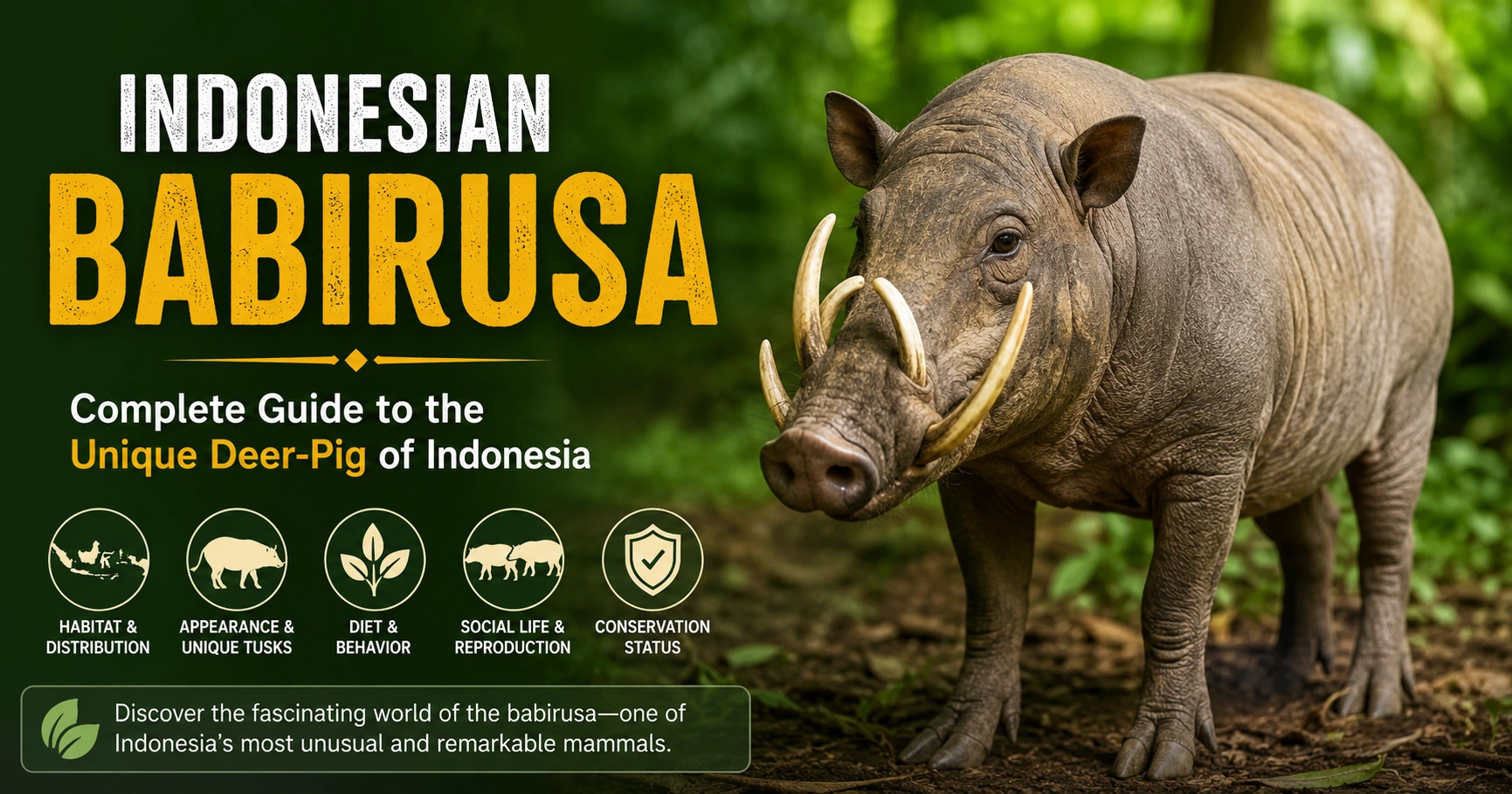
The babirusa of Indonesia is among the most interesting and bizarre mammals found in Southeast Asia. This interesting wild boar, native to a few Indonesian isles, can be identified easily by the unusual spiral of its upper tusks that is apparently related to its habits, its appearance, its forest habitat, and its history. In this post, the babirusa’s species, physical appearance, diet, behavior, reproduction, distribution, and conservation status will be discussed.
What Is an Indonesian Babirusa?
The Indonesian babirusa is an insular member of the family Suidae. Its most unusual feature is the large canines which curve backwards over the snout, making the animal look almost mythological. The most striking difference between the babirusa and any other pig is that the upper canines of the babirusa, which are much more prominent than the lower ones, grow through the skull and out and back over the snout – making it also known as a deer-pig.
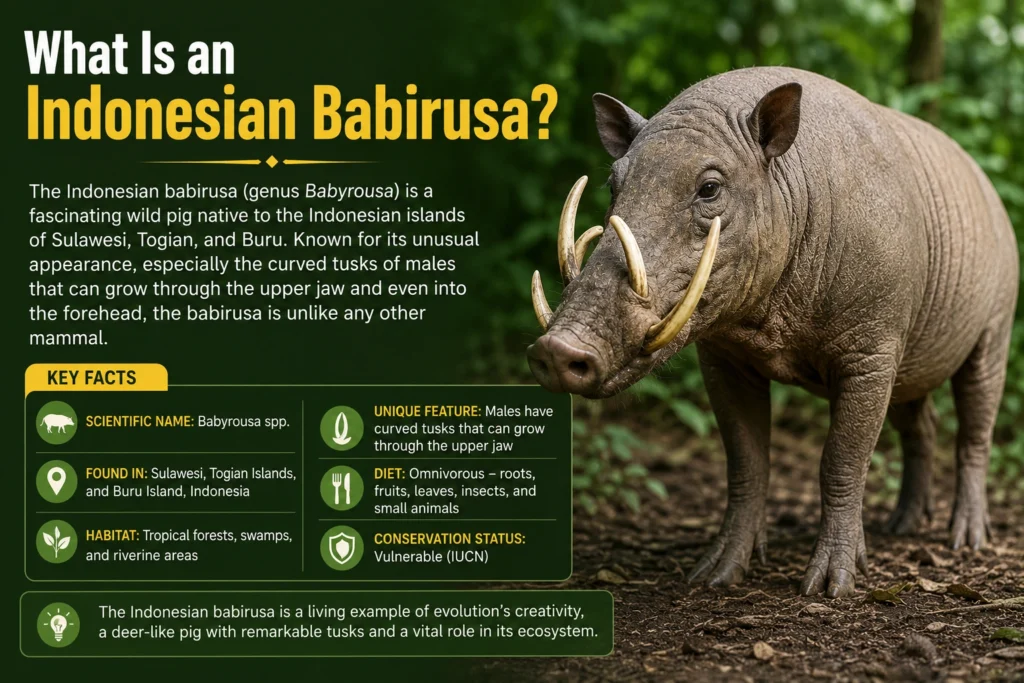
This is a true pig, not a deer, however, and it is related to the domesticated pigs and wild boars that we know. Most modern sources suggest that there is more than one species of babirusa, although previously all populations of the animal have been thought to belong to one. At present, the Sulawesi babirusa (B. celebensis) is assessed as Vulnerable, the Togian Islands babirusa (B. togeanensis) is Endangered, and the hairy or Buru babirusa (B. babyrussa) is also Vulnerable by the IUCN.
The most interesting thing about the Indonesian babirusa is probably the way the animals’ habitats are distributed. Babirusas were once common across the islands of Indonesia, but today they are uncommon in most of their former stretches. But there are a few spots and places where you can find these strange creatures. For example, on Sulawesi Island and surrounding small islands, which is the habitat of the Sulawesi babirusa, a second species, the Togian Islands babirusa, can be found on the Togian Islands.
The hairy babirusas may be seen on Buru and the Sula Islands of Mangole and Taliabu. This isolation of the populations of the babirusas is one of the reasons why they are endangered, since the destruction of one habitat can have much more significant impact than if the animal’s habitat is spread across a whole continent.
Why Is The Babirusa Called Deer-Pig?
Babirusa is an Indonesian word that means ‘pig-deer’. This is a reference to the strange double pair of tusks the animal grows out of its snout. The comparison to deer is misleading, however, since babirusas are more closely related to pigs. Instead, it describes their strange combination of pig-like body features and prominent, antler-like canine teeth. Their appearance can seem almost prehistoric, particularly when a mature male’s upper canines curve dramatically backward toward the forehead. These teeth are among the most recognizable characteristics of the genus and make the animal instantly different from ordinary wild pigs. The Sulawesi babirusa, in particular, has a relatively naked-looking body and conspicuous upper tusks.
The tusks also create one of nature’s strangest visual effects. Male babirusas have upper canine teeth that emerge through the upper snout and continue growing and curving. Depending on the species and individual, the teeth can take different shapes, so not every babirusa looks exactly alike. The Togian Islands babirusa has short, slender upper canines that rotate forward and converge, while the hairy babirusa has relatively short, slender upper canines that can cross the lower canines when viewed from the side. In other words, the famous babirusa “horns” are actually modified teeth rather than horns or antlers.
Indonesian Babirusa Species
The word “babirusa” can be misleading because there has previously been a lack of agreement amongst scientists about how many separate species there are. Discoveries of differences in the animals’ features and habitats have led to new classifications to more accurately represent the diversity of the various types of babirusas that have been found on different islands in Indonesia
According to current wildlife conservation resources, there are three known species of the babirusa that inhabit the islands of Indonesia, including the Sulawesi babirusa, the Togian Islands babirusa, and the hairy or Buru babirusa.
| Species of Babirusa | Nomenclature Scientifique | Principal Range | IUCN WPSG Status |
| Sulawesi babirusa | Babyrousa celebensis | Sulawesi and nearby islands | Vulnerable |
| Togian Islands babirusa | Babyrousa togeanensis | Togian Islands Archipelago | Endangered |
| Hairy/Buru babirusa | Babyrousa babyrussa | Buru, Mangole, and Taliabu | Vulnerable |
And these species differ from each other not just in their range but also in many other physical and ecological aspects, including size, fur density, tusk shape, tail, habitat, and more. For its part, the Togian Islands babirusa is called the largest of the three extant species by the IUCN Wild Pig Specialist Group. The hairy babirusa has a significantly thicker coat than Sulawesi’s one, which makes it look very different.
That is why scientists suppose that the isolated distribution of these subspecies in different Indonesian islands led to the variations in their appearance and habitat. However, they all have unique and fascinating features, just like any other babirusas.
Where Does the Indonesian Babirusa Live?
The Indonesian babirusa’s preferred Endemic ecosystem is the tropical region of forests and is associated with rivers, wetlands, ponds, and other water sources. The species’ habitats differ depending on their location and land distribution. The Sulawesi babirusas are found in association with tropical rainforest and have a notable affinity for swamps and rivers. On the other hand, the Togian Islands babirusas are linked to the tropical rainforests of rivers and ponds with aquatic plants.
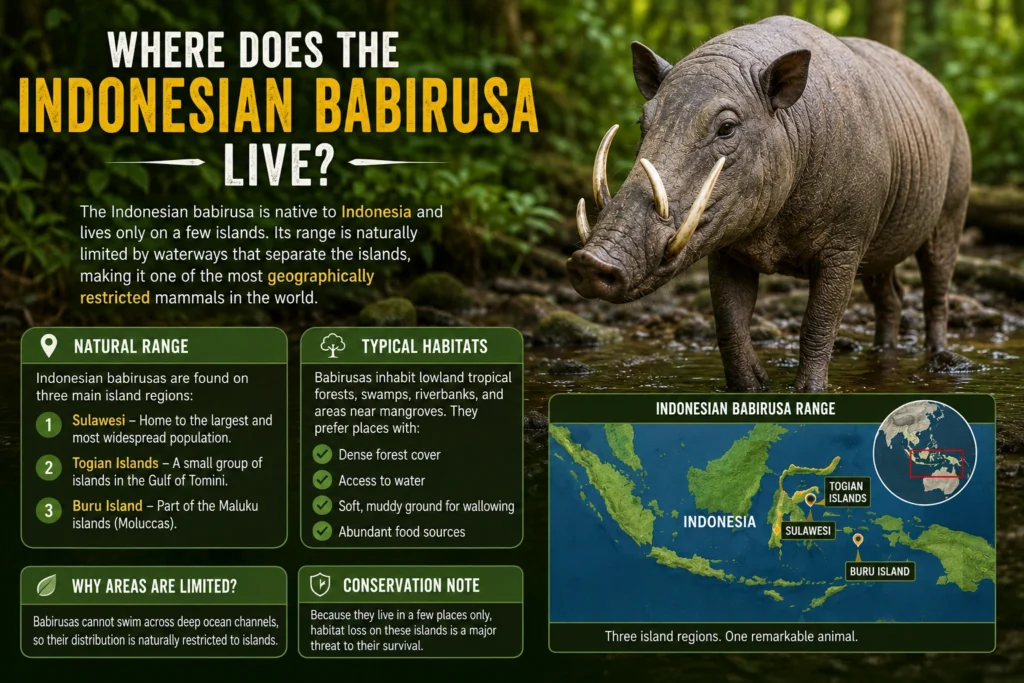
Meanwhile, the hairy babirusas dwell in the mountainous regions of Buru and the Sula Islands of Mangole and Taliabu. The vegetation is characterized by tropical lowland evergreen and semi-evergreen rainforests, as well as montane rainforests. Local inhabitants of Buru describe the animal’s presence in hilly and mountainous areas, although research on the species is considered insufficient.
Isolated locations have led to the development of uniqueness among the babirusa. The island region is one of Indonesia’s geographical features that have led to the development of biodiversity in the country. Since the archipelago was separated, the animals and plants in this area have evolved greatly. One of the nation’s remarkable wildlife finds is the babirusa, a unique mammal that has evolved very interesting features.
What is the Appearance of a Babirusa?
Overall, the animal looks like a tall and slender wild pig. However, the babirusa differs from the typical representatives of the family in many ways. For instance, the Sulawesi variety has a relatively short and sparsely distributed coat of hair, making the animal look almost nude. Meanwhile, the hairy babirusa has a highly noticeable coat. In addition, all varieties have rather long legs, allowing them to look taller than the representatives of their family.
Still, the most prominent feature of these mammals, without which it is not possible to confuse them with other domestic or wild animals, is their upper canine teeth. The permanent teeth of these animals grow through the top of the snout at an upward angle, taking a right turn and growing back. Moreover, they differ significantly among the described subspecies. These rather unusual formations are of great interest to scientists who study the natural history of the animal, but they did not appear to complicate the survival of the babirusa. Perhaps this is one of the simplest ways to distinguish these animals from their relatives.
Another feature that may be used for identification is the shape of the tail. The variety inhabiting the Togian Islands has a well-developed tuft at the end of the tail. However, the hairy babirusa also has a noticeable tail tuft, which is even more remarkable.
How Big Is an Indonesian Babirusa?
The size of the animal varies depending on the type, sex, age, and individual characteristics – for example, the Togian Islands babirusa is the largest of the three surviving species. However, when visualizing the animal, one should avoid thinking about some giant boar, but rather imagine a reasonably sized, somewhat elongated wild pig, similar to the domestic ones, but with a slender and elegant body. Such an impression is explained by the disproportionate dimensions of the animals’ skulls, which give them an unusual appearance and make them look strange in comparison with other suids.
Various resources provide different measurements and descriptions, and therefore it seems safer to use adjectives in this task instead of specific numbers that seem to be conditionally accurate for each case. This refers particularly to the animals that live on islands, since they tend to evolve lighter or heavier than their mainland relatives depending on the circumstances.
What Does the Indonesian Babirusa Eat?
The Indonesian babirusa is a forest dweller and omnivore, but is largely dependent on what food sources are available to each subspecies. Yet plant material constitutes most of the diet, such as leaves, roots, fruits, rhizomes, herbs, and other kinds of vegetation. For example, the Togian Islands’ babirusas consume rhizomes, fallen fruit, annual herbs, and even vegetables. Researchers suggest that these animals may also consume small mammals and birds, particularly the Sulawesi subspecies.
It is not surprising that these babirusas are opportunistic feeders. The tropical forest is quite diverse, so there is a variety of animal and plant foods. But for an all-round omnivore, it is not possible to depend upon a single resource, for it might not be adequate. Therefore, babirusas are natural diggers and can locate various plant materials on the ground of the forest. This ability, combined with the use of various other food items, makes them true omnivores.
The hairy babirusa is also a general opportunistic feeder. Buru locals are convinced that they live off leaves, roots, and fruits from the jungle. Still, at ebb they are foraging on the beach. The people say that the babirusas do not go to the gardens to feed, as the pigs they have in Buru eat the crops in the garden.
Indonesian Babirusa Facts
The babirusa’s behavior is intriguing and, in some cases, poorly understood. The Sulawesi babirusa seems to be the most social species out of the four, with reports of groups of up to 13 individuals. However, such meetings are rare, and females and their young usually form the groups. As for males of this subspecies, they are solitary, live in bachelor groups, or associate with female groups temporarily. In general, they are about fetching daylight-hunters, “a foraging animal”.
The Togian Islands form of the babirusa occurs in small groups consisting probably of one or two adults with their offspring. It should be noted that the data is inconclusive, as different locals reported varying details. The survey and interviews conducted within the region provided valuable information on the social structure of these animals.
The third subspecies, which is the hairy babirusa, seems to be less social than the first two, with many individuals observed to be lone wanderers, although some may form small groups as well. The locals of Buru said that they mostly encounter the animals in the early morning and late afternoon, rarely during the midday. Therefore, it can be concluded that there are, in fact, differences between these animals in terms of behavior and social system, and hence each babirusa subspecies should be treated separately.
How do Babirusas Communicate?
Babirusas are likely to employ the same set of communication tools, including vocal signals with other wild pig species, body posture, pheromones, and possibly even other methods. But there is far less information on the behavior of babirusas than that of some of their nearest relatives. Local inhabitants of Buru have reported hearing a unique, long, high-pitched call from groups of babirusas they have encountered in the wild. This is an important consideration when studying wildlife, and an informative example for humans to take into account when researching reclusive species. After all, it is sometimes necessary to get up close and personal to make new biological discoveries;
especially within thickly forested environments where line of sight may be limited.
Therefore, sound and scent can serve as critical tools for animals who need to maintain contact, convey danger and other messages, and establish relationships despite the challenge of limited visibility.
Reproduction and Young
Babirusa reproduction remains an area where researchers still have knowledge gaps. The breeding behavior of the Togian Islands and hairy babirusas is not well documented, and some information has been inferred from the better-studied Sulawesi babirusa. Local observations of Togian Islands babirusas indicate that females can produce small litters, with reports of two to three young.
Limited reproductive information presents a challenge for conservation. To effectively conserve a species of a vulnerable animal, it is critical to gain an understanding of not only the distribution of the animals but also of the rate at which they can reproduce and recover from decreases in numbers. If the population size of a species is relatively small, its habitat is limited, and it cannot recover rapidly, even relatively light levels of exploitation and disturbance may threaten it.
Why Are Indonesian Babirusas Endangered?
The main threats posed to the Indonesian babirusas are closely associated with the processes of habitat loss and human hunting. Deforestation, agriculture, logging, wildfires, and human disturbances can have negative effects by decreasing or dividing their habitat. When the populations of these animals are disrupted, they can be severely decreased, especially when isolated groups have little land to live on.
The Togian Islands subspecies of babirusas are vulnerable to the threat of forest fires, dog attacks, and the destruction of their natural habitats. The IUCN Wild Pig Specialist Group considers that the animal’s distribution is “restricted” and that the species is “particularly vulnerable despite its presence in protected areas.” On the island of Malenge, burning forests have destroyed much of the potential habitat for these creatures, lowering the availability of food even if the animals have survived the fires.
The biggest threat to babirusa in general is hunting by humans for meat and habitat destruction from logging. The animal occurs in several protected areas, but wildlife experts agree that the species is greatly reduced. Furthermore, the status of distribution of the Sulawesi babirusa is confused, and in some habitats they may be absent.
Conservation Status of the Indonesian Aboriginal Babirusa
The conservation status of the babirusa varies depending on the species, which makes blanket statements such as “the babirusa is endangered” problematic at best. According to the IUCN Wild Pig Specialist Group, the Sulawesi representative is regionally classified as ‘Vulnerable,’ the ‘Togian Islands’ subspecies is ‘Endangered,’ and the ‘hairy’ variety is ‘Vulnerable.’
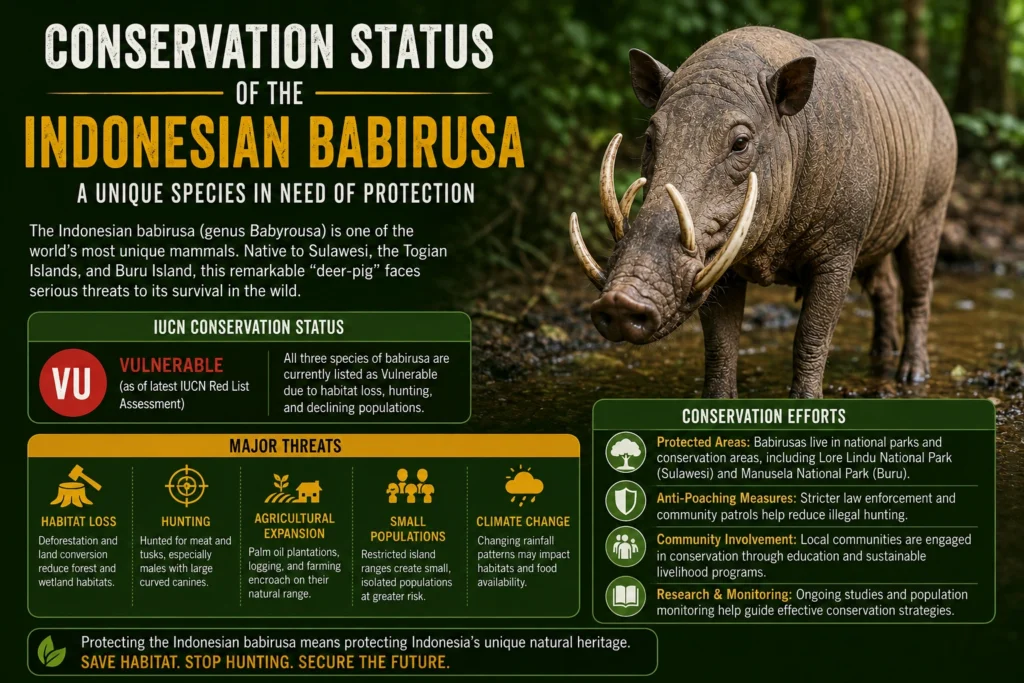
This discrepancy illustrates the varying levels of concern for each species’ survival and places the Togian Islands variety at the greatest risk. Its ‘Endangered’ classification is appropriate, given its restricted distribution in the Togian Islands. A species that only exists in a few local areas faces significantly greater risks from catastrophic environmental occurrences.
The babirusa also has an extensive history of legal protection in Indonesia. The IUCN Wild Pig Specialist Group notes that the entire genus ‘Babyrousa’ was given full legal protection beginning in 1931, and the animal was added to CITES Appendix I in 1982 in its original taxonomic nomenclature.
How can we improve Babirusa conservation?
The babirusa is among the most endangered mammals, and there need to be much better conservation efforts for such animals. The conservation of forest ecosystems should be implemented to ensure the species’ survival. The hunting of babirusas should also be prevented or regulated. Additionally, their habitats should be connected if it is possible, and population numbers should be studied and monitored. But it would only be possible if local communities participated actively, their livelihoods were not threatened, and conservation work was focused on human and nature-related problems.
Protected areas, while important, should also be well managed and patrolled. It is not enough to mark the locations on the maps; rangers should be equipped, and wild animals should be studied. Local ecosystems, in turn, require maintenance and management as well. It is also essential for conservationists to have practical knowledge and up-to-date information regarding animal census, behavior, and population.
The conservation of babirusas is particularly important because of the animal’s current endangered status. That is why studying them is necessary as well. Scientists might better understand babirusas’ habitats and diets, the timing of breeding, migration, and more. But the scientists are going to need your help. Information about the species would enable conservationists to take the right steps to save them from extinction.
Indonesian Babirusa vs. Other Wild Pigs
| Feature | Indonesian Babirusa | Typical Wild Boar |
| Genus | Babyrousa | Sus |
| Famous feature | Curved upper canine tusks | Large lower and upper canine tusks |
| Body appearance | Often slender and long-legged | Generally more robust |
| Biogeography and status | Closed Indonesian Islands by Permits | A much wider areal coverage |
| Habitat | Tropical rainforests, marshes and areas associated with rivers | In forests, grasslands, agricultural fields, and numerous other habitats |
| Conservation status | Several species are in danger | Depending on the species and population, though, it can vary considerably. |
The comparison highlights why babirusas deserve special attention. A wild boar can occupy a very broad geographic range, whereas individual babirusa species may be confined to particular Indonesian islands. When a species has a narrow distribution, habitat destruction can remove a substantial percentage of its available habitat much more quickly.
Amazing Facts of Indonesian Babirusa
The babirusa is a fantastic animal, and this strange mammal has a suite of unique characteristics that clearly distinguish it from other animals. For one, while it is actually a pig, the babirusa has a strange look that bears no resemblance to the domesticated creatures people find themselves looking at every single day. On the babirusa’s upper jaw, the animal’s canines permanently grow upward and outward. Moreover, these mammals have a wide distribution of morphological variations, with each species showcasing different tusk types. The Togian island babirusa is the largest member of the pig family, whereas the hairy babirusa is the hairiest one
It is also noteworthy that the babirusa’s habitat is rather limited, which probably explains the animal’s bizarre appearance. This area, however, is most likely not the reason why the species is still surviving, as the babirusa is not some sort of an ancient relic that has been existing on the planet for hundreds of millennia. And yet the babirusa is a modern-day creature that coexists with us humans. But the most surprising fact about the babirusa is that the species is much more significant than one may imagine, simply because saving these pigs equals saving the entire local eco-region.
The Role of Indonesian Babirusa
Is there any particular reason why people should become interested in some exotic-looking pig? Why should they care about a rare animal that inhabits several islands of Indonesia? Such a question arises when the public becomes aware of exotic species and their potential extinction. However, an animal’s appeal is not necessarily related to its uniqueness, which is undeniable even if one species turns extinct. The babirusas are only one example of an animal that lives in a place where an incredibly diverse range of wildlife species can appear.
The existence of such mammals demonstrates that the isolation of certain territories can lead to the development of endemic species. At the same time, the survival of the Indonesian babirusa is directly linked to the preservation of forests, watersheds, and wetlands, as well as the study of this issue in order to find out exactly what needs to be done to stop further reductions in the numbers of these animals. Apart from being an indicator of healthy ecosystems, babirusas play a crucial role in the study of the local region and its needs.
External Links
- IUCN Wild Pig Specialist Group — Sulawesi Babirusa
- IUCN Wild Pig Specialist Group — Togian Islands Babirusa
- IUCN Wild Pig Specialist Group — Hairy Babirusa
Internal Link: Indonesian Babirusa
Discover the fascinating “Indonesian Babirusa,” a unique wild pig known for its unusual deer-like appearance, remarkable curved tusks, natural habitat, behavior, diet, and conservation challenges. Learn more about this extraordinary Indonesian mammal and why protecting its forest habitat is essential for its survival.
Conclusion
The Indonesian babirusa is one of the most fascinating mammals that inhabit Southeast Asia. This animal’s uniqueness is determined by the peculiar shape of its continuously growing canine teeth, uncommon long-legged build, occurrence in insular regions, and ecological requirements. Today, the International Union for Conservation of Nature (IUCN) recognizes the existence of several species of this rare pig, including the Vulnerable Sulawesi, Endangered Togian Islands, and Vulnerable hairy or Buru babirusa. However, the scientific interest in the species’ extraordinary morphology was not the main challenge in the study of these animals.
The reason for concern is the animals’ low adaptability to the environment and the possibility of losing populations due to anthropogenic activities. Such threats as hunting, habitat loss, sylvatic outbreaks, agricultural expansion, disturbances, and other human-related impacts require an immediate conservation response.
The most promising directions of intervention in these animals’ decline are the preservation of natural habitats, enhancement of scientific research, development of protected areas, and community-based programs of biodiversity conservation. Ultimately, the Indonesian babirusa is not only an interesting anomaly but also a unique part of Indonesia’s biodiversity that should be preserved for future generations.
FAQs about the Indonesian Babirusa Essay
1) Does the babirusa live in the same pork industry as pigs in Indonesia?
Yes, the Indonesian babirusa is a member of the animal order Suidae and the family “Sus” to which all pigs belong. However, the babirusa is a unique genus, known as “Babyrousa“. This is a wild pig with a slender body structure, a somewhat distinctive facial structure, and a pair of long canines, which grow upward and over the skull, taking a semicircular direction. Those peculiar elongated tusks, which become more prominent in males, are the most distinctive feature of this species. In addition to the pig’s family traits, the babirusa has a unique appearance.
2) What makes the Indonesian babirusa’s tusks unique?
The babirusa’s most remarkable feature is undoubtedly its canine teeth, which qualify it to be one of the most unusual mammals in the world. Males have the most developed canines that curve in a circular direction above the skull, while females do not have them. It is impossible not to note these animals’ unusual and unique elongated tusks, which can serve as a marker of the species. Tusks are a normal part of peccary and even wild boar anatomy, but they are an anomaly in babirusas. This is particularly so in the Sulawesi subspecies, the Togian and Buru island birds having it in males only.
3) What do the Indonesian babirusas eat?
Indonesian babirusas are broadly omnivores, primarily eating plants but sometimes also eating animals. But they are mainly vegetarian. Leaves, roots, fruit, rhizomes, and herbs are on their menu. Moreover, the babirusas are known to be insectivorous and occasionally eat snakes and other animals, often in the Togian and Sulawesi subspecies. The composition of the diet may vary depending on the season and availability of certain types of food.