
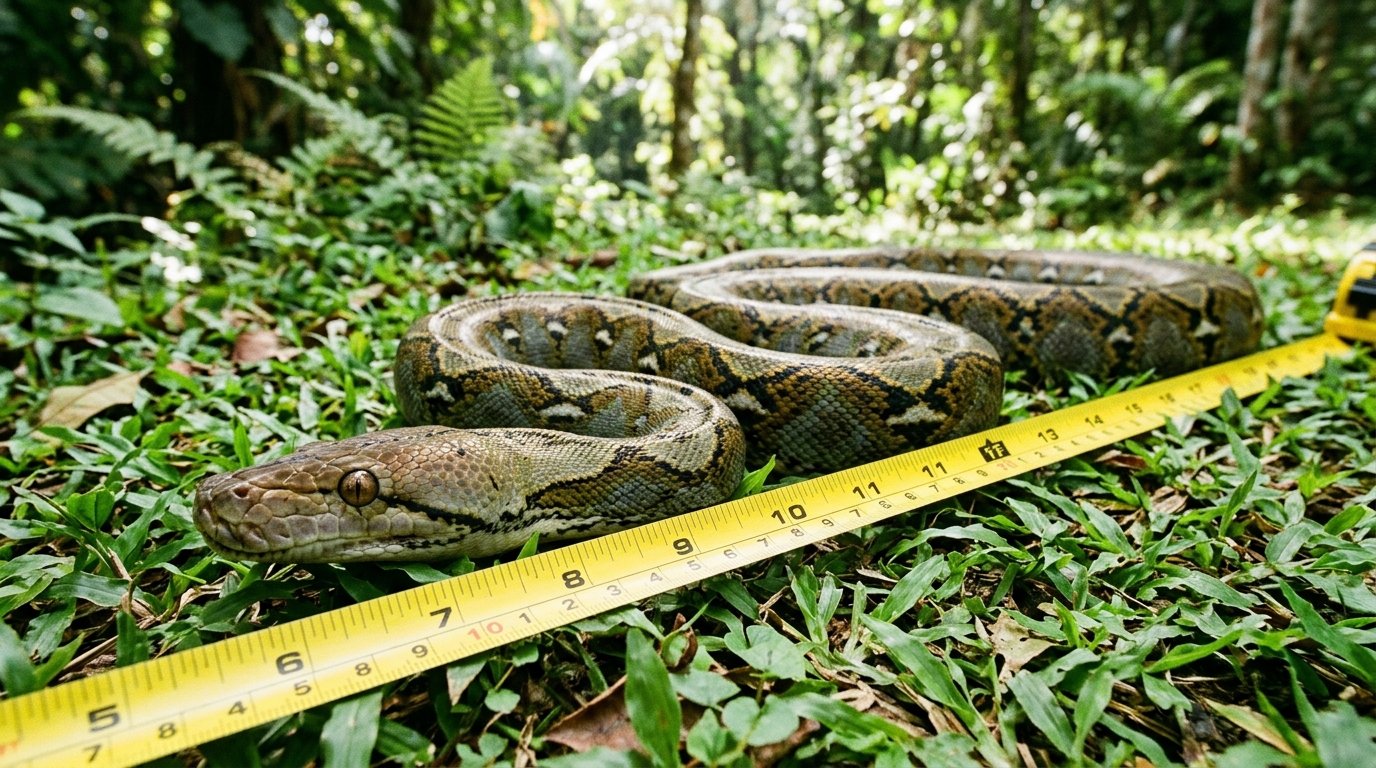
The reticulated python is generally the world’s longest snake, but a dramatic claim is not automatically a verified record. You may find huge figures in old reports, news stories, and online searches. A careful look at how each animal was measured helps you tell a documented record from a tale that grew over time.
Constriction is the process of a snake wrapping its muscular body around prey and tightening its coils. Length and weight are separate ways to describe a giant snake. A long, slender animal can stretch farther than a shorter, heavier one, so a single “biggest” label can hide an important difference.
When you compare records, check the animal’s condition and the way the tape followed its body. A measurement taken from a live snake does not mean quite the same thing as one taken from a dead animal or its skin. Understanding the animal’s biology alongside its size makes it easier to separate fascination from folklore.
Key Takeaways
- Reticulated pythons are generally considered the world’s longest snake species.
- Length and weight describe different kinds of size.
- Measurement conditions matter when you compare records.
- Claims without clear records are not verified measurements.
- A large python can be dangerous even though it is nonvenomous.
The Largest Reticulated Python: How Big Can It Get?
The 6.95 m wild measurement was taken under full anesthesia, while Ibu Baron was measured alive at 23 ft 8 in. Those figures describe different measurement conditions, so they are not direct equivalents. Reticulated pythons are generally considered the longest snake species, but claims about extreme length need context.
For someone searching for the biggest snake in the world found alive, Ibu Baron is a notable example. The largest python ever recorded depends on whether you mean a live measurement, an anesthetized animal, or an older claim.
Measurements From Wild Snakes
A female found in East Kalimantan, Borneo, measured 6.95 m (22 ft 10 in) under full anesthesia in August 1999. A paper about the snake appeared in the Raffles Bulletin of Zoology in 2005. The animal weighed 59 kg, and its sex was not determined.
The report also describes the python swallowing an adult female sun bear. The bear was likely weakened before the encounter. The field report on the 6.95 m python records both the measured length and this rare event.
Ibu Baron was measured alive in Maros, Sulawesi, in December 2025. The snake measured 23 ft 8 in and weighed 96.5 kg (213 lb). Her live measurement offers a useful comparison, though it was not taken under full anesthesia.
| Snake or record | Place and date | Length and condition | Weight or evidence |
|---|---|---|---|
| 1999 female | East Kalimantan, August 1999 | 6.95 m, fully anesthetized | 59 kg; sex undetermined |
| Ibu Baron | Maros, Sulawesi, December 2025 | 23 ft 8 in, measured alive | 96.5 kg (213 lb) |
| 1912 Sulawesi claim | Sulawesi, 1912 | 10 m claimed; condition unclear | Documentary evidence is scarce |
Historic Claims and Their Limits
A 1912 account claimed a Sulawesi python measured 10 m (32 ft 10 in). Scientific reports have also recorded lengths up to 10.05 m (33.0 ft), but those reports are not firmly verified. Most estimates above 6 m (20 ft) have been questioned, so a reported figure is not automatically a confirmed record.
Separate captive records from wild measurements when comparing the largest snakes.
Is the Reticulated Python the Longest or Heaviest Snake?
By length, the reticulated python holds the edge; by weight, the green anaconda is the heavyweight. Reticulated pythons are generally longer and less bulky, while green anacondas are heavier overall. Typical reticulated python size ranges from 3-6 m (9 ft 10 in-19 ft 2 in), with longer individuals documented occasionally.
That range helps put reports about Medusa, a captive python, in context. Medusa reportedly measured 7.67 m (25 ft 2 in) and weighed 158.8 kg (350 lb) in 2011. Both measurements are considered somewhat reliable, but one exceptional animal does not set the usual size for its species.
Green anacondas typically weigh 30-80 kg (66-176 lb) as adults. In a seven-year study from 1992-98, the heaviest of 780 captured green anacondas weighed 97.5 kg (215 lb). That measured maximum shows why the anaconda earns its reputation as the heaviest snake.
| Snake or case | Measurement type | Value and condition |
|---|---|---|
| Reticulated python | Typical length | 3-6 m (9 ft 10 in-19 ft 2 in) |
| Medusa | Captive length and weight | 7.67 m and 158.8 kg, reported in 2011 |
| Green anaconda | Typical adult weight | 30-80 kg (66-176 lb) |
| 780 green anacondas | Maximum weight in 1992-98 study | 97.5 kg (215 lb) |
Stories of green anacondas measuring 11-12 m (35-40 ft) or longer lack hard evidence. No specimens of those lengths have been placed in a museum. This does not change the weight comparison: the python leads in length, and the anaconda leads in weight.
Do not present one captive giant’s measurements as the typical size of its species.
How Do You Verify a Giant Snake’s Length?
A credible giant-snake measurement needs a documented method and a clear record of the animal’s condition. Without both, a reported length cannot be compared fairly with a well-recorded measurement. A living snake is hard to straighten fully, and its body can curve during measuring.
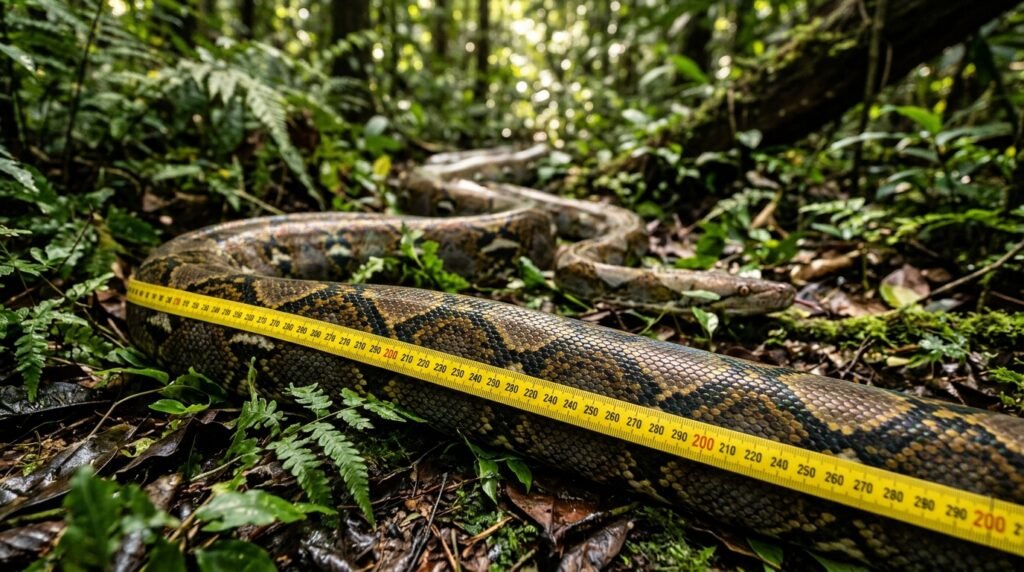
Death and skinning can change the result, too. A removed hide may stretch roughly 20-40% or more during skinning, so its length may not match the live animal’s natural length.
Colossus shows why the details matter. It was reported to measure 8.7 m in November 1956. After its death in 1963, its skeleton measured 6.35 m, while its fresh hide measured 7.29 m.
Use these checks when you assess a claim:
- Was the snake alive, anesthetized, or dead when measured?
- Did the tape follow the body’s curves, or measure a straight line?
- Was the full measurement recorded, rather than recalled later?
- Does a traceable specimen or measurement record still exist?
Claims about the world’s largest snake at 48 feet or 200 feet have no firmly verified specimen behind them. A huge number can spread without a measured animal or a record that others can inspect. Details about the pattern and scales may help identify a snake, but they do not prove its length.
Treat a length without a stated measurement condition as a claim, not a comparable record.
Where Does the Reticulated Python Live, and What Does It Eat?
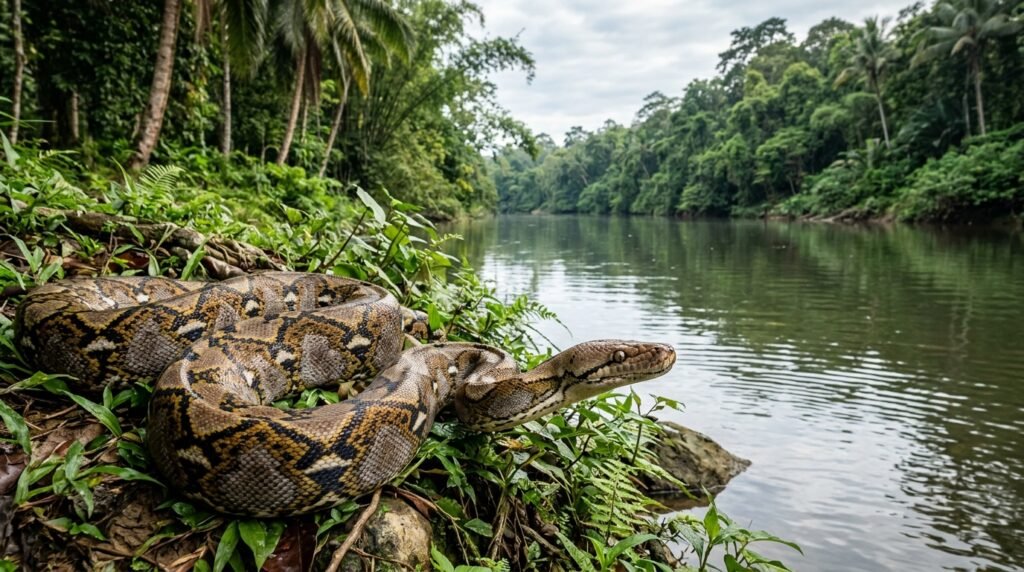
Reticulated pythons range across South and Southeast Asia, occupying forest, woodland and river-adjacent habitats. Their range includes waterways and islands, not only dense rainforest. Their scientific name is Malayopython reticulatus.
Habitat Across South and Southeast Asia
The range spans India, Bangladesh, Myanmar, Thailand, Laos, Cambodia, Vietnam, Malaysia, Singapore, Indonesia, and the Philippines. These snakes live in rainforests, woodlands, nearby grasslands, and areas close to rivers and lakes.
They are strong swimmers and have been reported far out at sea and on small islands. Rivers and coastal routes can connect places that seem far apart on a map. For broader animal and wildlife coverage, you can explore stories about many kinds of animals.
Ambush Hunting and Prey
The reticulated python is a nonvenomous constrictor. It waits for prey to come within striking range, then grabs it and uses constriction to subdue it. The muscular coils stop the prey from escaping.
The species name reticulatus refers to the netlike pattern across its scales. This pattern helps break up the snake’s body outline among leaves, shade, and forest litter.
Diet changes with body size. A python around 3-4 m long mainly eats small mammals, such as rodents, bats, and treeshrews. Larger animals may take civets, primates, pigs, and deer weighing more than 60 kg.
That wide range of prey reflects an ambush hunter’s chance to catch animals that come close. A python does not need to chase every meal across the forest. Its netlike pattern can break up the body outline against forest litter, making a large snake difficult to spot.
How Long Can Reticulated Pythons Live, and Are They Dangerous?
A reticulated python can live for decades in captivity, but its lifespan and size depend on whether it is wild or captive and on its population. Wild snakes typically live 15-22 years, while captive animals have lived up to 32 years. A large nonvenomous python can still seriously injure a person.
Lifespan and Reproduction
The typical wild lifespan of 15-22 years differs from the longest known captive lifespan. Females are generally the largest reticulated pythons. They lay clutches of 15-80 eggs, which take an average of 88 days to hatch at 31-32 C.
Hatchlings measure at least 60 cm long. Island dwarf forms stay smaller than mainland snakes, and selectively bred super dwarfs typically measure 1.82-2.4 m as adults. Those size differences reflect both population and breeding.
Why Close Encounters Carry Risk
Human fatalities are rare, but they have occurred. In March 2017, 25-year-old farmer Akbar Salubiro was found inside a 7 m python in Central Mamuju, West Sulawesi. The case shows that a large constrictor can pose a serious risk, even though it has no venom.
Keep a safe distance if you see one. Take these steps:
- Do not approach or handle a large python.
- Keep children and pets away from the snake.
- Contact trained local wildlife responders.
Wait for qualified responders from behind a secure barrier rather than moving closer to the snake.
Conclusion
The reticulated python’s reputation rests on real size, even though not every giant-snake claim holds up. It is generally the longest snake, while the green anaconda is heavier. A length claim means more when you know how the snake was measured and what record remains.
You can observe a python without handling it. A close approach puts you and the snake at risk, especially when its size is hard to judge. If you encounter a large python, keep your distance and contact a qualified wildlife responder.