
Pink Dolphin: Your Beginner’s Guide to This Rare Animal Species
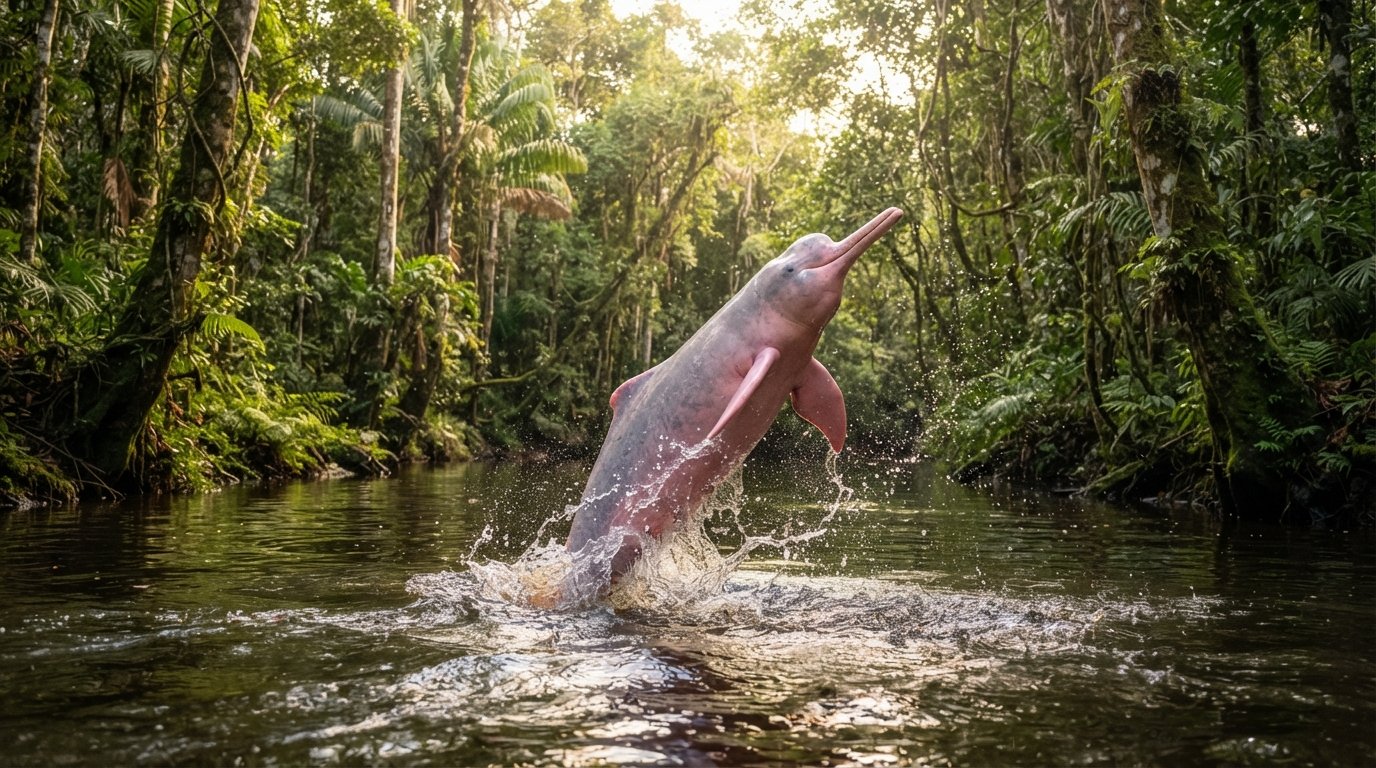
A pink dolphin in a South American river is usually an Amazon river dolphin, but the name can describe more than one kind of animal. These freshwater mammals stand out in the world for their unusual color and their life among the waters of the Amazon rainforest. Learning which animal a name describes helps you understand where it lives and what it needs.
This guide focuses on the river species, from its changing color and daily behavior to the pressures on its habitat. It also separates the Amazon animal from other dolphins that may look pink or share the same common name. Keep the river setting in mind as you learn what makes this animal distinctive.
Key Takeaways
- The Amazon river dolphin is a real freshwater toothed whale.
- Its pink color often grows stronger with age.
- Flood seasons open forest and plain habitat to river dolphins.
- Wild dolphins need space and should not be touched or fed.
- Fishing, pollution and river changes threaten their future.
- Other pink-looking dolphins may belong to different species.
What Is a Pink Dolphin?
The Amazon river dolphin is a real freshwater toothed whale, not a legend or a marine dolphin. Inia geoffrensis is the scientific name for the South American freshwater species often called a pink river dolphin. It belongs to the toothed whales, a group that also includes ocean dolphins and porpoises.
People also call this animal the boto or bufeo. The names amazon pink and amazon pink river dolphin point to the same river species, not a separate kind of whale. Pink dolphins in the Amazon are this freshwater species.
So, is the pink dolphin real? Yes, the Amazon river dolphin is a living animal, and its name does not come from a folktale. The common name can also describe other animals, though, so the name alone does not identify a species.
For example, people sometimes call the Chinese white dolphin a pink dolphin. The Chinese white dolphin is a separate coastal animal, not a member of the Amazon river population. Some unusually pink dolphins may also have albinism, a rare genetic trait that reduces normal pigment.
Inia geoffrensis has a body suited to fresh water and a long snout for finding food in river habitats. It is not the same as a marine dolphin that happens to look pink. That distinction matters when you read about sightings, habitat or conservation.
Pink dolphin facts can refer to more than one animal, so check the species name when accuracy matters. A report about a pink dolphin in the Amazon refers to the boto, while a report from coastal waters may describe another species. Use Inia geoffrensis when you want to distinguish the Amazon species from other animals called pink dolphins.
Where Do Amazon Pink River Dolphins Live?
You can find Amazon river dolphins across six South American countries, in the Amazon and Orinoco basins. Their range includes Brazil, Peru, Colombia, Bolivia, Ecuador and Venezuela. They live in freshwater rivers and connected waterways, not in the ocean.
Examples from the Peruvian Amazon and other river basins show how wide the range is. A river dolphin’s local range can include a main channel, smaller streams and seasonal wetlands. Capybaras also live near South American rivers and flooded grasslands, where changing water levels shape life for many animals.
Across the Amazon Basin
The Amazon river basin holds many known populations, from the Rio Negro to the upper Madeira. The Orinoco River basin forms another large part of the species’ range. The Amazon and Orinoco connect a wide mix of channels, lakes and floodplains.
| Example location | Country | River basin |
|---|---|---|
| Rio Negro | Brazil | Amazon |
| Upper Madeira | Bolivia | Amazon |
| Caqueta | Colombia | Amazon |
| Peruvian Amazon | Peru | Amazon |
| Orinoco River | Venezuela | Orinoco |
How Flood Seasons Shape Their Range
Rain changes the size of the habitat through the year. In wet months, rising rivers spill across plains and into flooded forests, opening areas that are dry land in other seasons.
Dolphins can enter those forest channels and broad floodplains while high water lasts. In the dry season, falling water draws them back toward deeper river channels. These shifts can change where you might spot them, even within the same river system.
Flooding also links waterways that become separate when water levels fall. The dolphins use these changing routes as part of their freshwater range. A flooded forest is part of their river habitat during high water, not a separate marine range.
Why Are Amazon River Dolphins Pink?
Amazon river dolphins are born gray and develop pink coloring as they grow older. Their color often changes with age, but no single shade defines every adult. Some adults look mostly gray, while others show strong pink patches or broad pink areas.
Males are generally pinker than females. That is a broad pattern, not a dependable way to identify an individual’s sex. Color can vary greatly among dolphins of the same age and sex.
Small blood vessels near the skin can affect how pink a dolphin appears. Behavior may also change its visible shade, as blood flow shifts during activity or excitement. Sunlight exposure and diet can play a part in the color seen on the body.
Adult patterns may look solid or mottled, with gray and pink mixed together. A dolphin with mottled skin can look different when seen from another angle or under changing light. Those patterns make photographs an imperfect guide to its usual appearance.
Color alone cannot tell you a dolphin’s age, health or sex. You may see males with less pink than some females, despite the general difference between them. The trait varies from one animal to another and can shift over time.
The name pink river dolphin describes a common look, not a fixed coat color. An animal may also appear more or less pink as its behavior and surroundings change. Treat pinkness as a variable trait, not a fixed shade shared by every dolphin.
What Does an Amazon Pink River Dolphin Look Like?
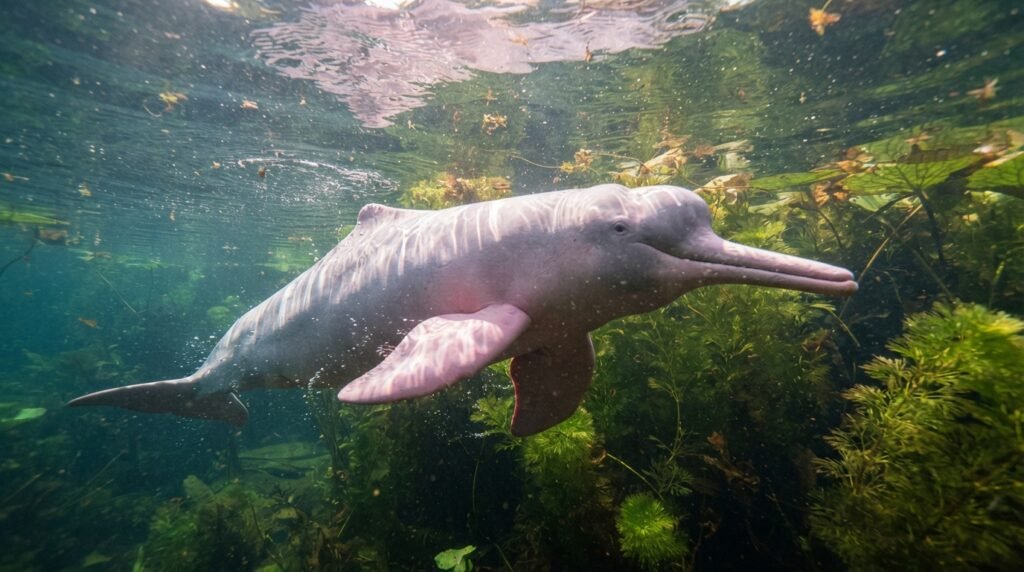
A full-grown Amazon pink river dolphin can reach 9 feet long and weigh up to 400 pounds. That size makes it the largest-bodied freshwater dolphin species. Its shape also helps it move through narrow channels and flooded woodland.
The body is thick, but the snout is long and narrow. A rounded melon, the bulge on the forehead, helps focus sounds. Broad pectoral fins and a low dorsal fin complete a shape unlike the sleek outline of many ocean dolphins.
Size and Body Shape
The pectoral fins are paddle-shaped and help the animal turn and steer. Its low dorsal fin does not form the tall, curved shape many people picture on a dolphin. These body features suit a life among tree trunks and uneven river bottoms.
Look for these four features if you are trying to recognize a river dolphin:
- Long, narrow snout
- Rounded melon on the forehead
- Broad, paddle-shaped pectoral fins
- Low dorsal fin
Its build is less streamlined than that of many sea-going dolphins. The flexible body and broad fins help it make tight turns in shallow water. A brief view may show only the snout or back, so more than one feature helps with identification.
A Large Brain and a Long Life
Amazon river dolphins can reach 9 feet (2.7 meters) and weigh up to 400 pounds (181 kilograms). They can live to about 30 years old. Among freshwater dolphins, the species has the largest body and brain.
Some accounts describe its brain as having 40 percent more capacity than a human brain. Brain capacity refers to size or volume, not a direct measure of reasoning, memory or problem-solving. It does not provide a fair IQ comparison between different species.
A large brain can support complex behavior, but size alone cannot explain how an animal thinks. Scientists need suitable tests to compare specific skills across species. Brain capacity alone does not establish that one species has a higher IQ than another.
How Do Pink River Dolphins Navigate and Find Prey?
In murky river water, Amazon pink river dolphins use sound to build a picture of their surroundings. They rely on echolocation when low visibility makes sight less useful. This sense helps them find prey and move through dark or cloudy water.
Echolocation is sensing nearby objects by sending out sounds and interpreting the echoes that return. The dolphin sends high-frequency clicks and listens for echoes that bounce off objects. Those returning sounds help it detect prey, river features and obstacles.
Echolocation in Murky Water
The clicks and echoes create a three-dimensional echogram, a sound-based picture of nearby space. Toothed whales can make 30 to 80 echolocation clicks per second. The fast stream of sound gives a dolphin frequent updates as it swims.
In clear water, vision can help an animal see what lies ahead. In muddy channels or dim forest water, sound offers another way to sense nearby objects. Echolocation can help a dolphin locate food even when it cannot see far.
The echo changes depending on the object that reflects the sound. A fish, a tree trunk and a riverbank return different signals. The dolphin uses these signals to judge the position of nearby features.
Turning Through Flooded Forests
The neck vertebrae of Amazon river dolphins are not fused together. That allows the head to turn as much as 90 degrees, unlike the stiff neck of many other dolphins.
This movement helps the animal look and steer around tree trunks, branches and other obstacles. It can also turn its head while its body continues along a different path. Such control matters in flooded forests, where open water may be broken by roots and trees.
A rigid neck would limit those quick head movements. The flexible neck helps the dolphin scan its surroundings without turning its whole body each time. Their flexible neck helps them turn through tight river spaces that a rigid neck would make harder to navigate.
What Do Amazon Pink River Dolphins Eat?
Amazon pink river dolphins eat a varied diet that includes more than 53 species. Fish make up much of the menu, but turtles and freshwater crabs are also prey. The food they find depends in part on water levels and where prey gathers.
Recorded prey includes piranhas, croakers, catfish and tetras. The list also includes river turtles and freshwater crabs. These animals offer different food options across the dolphin’s river habitat.
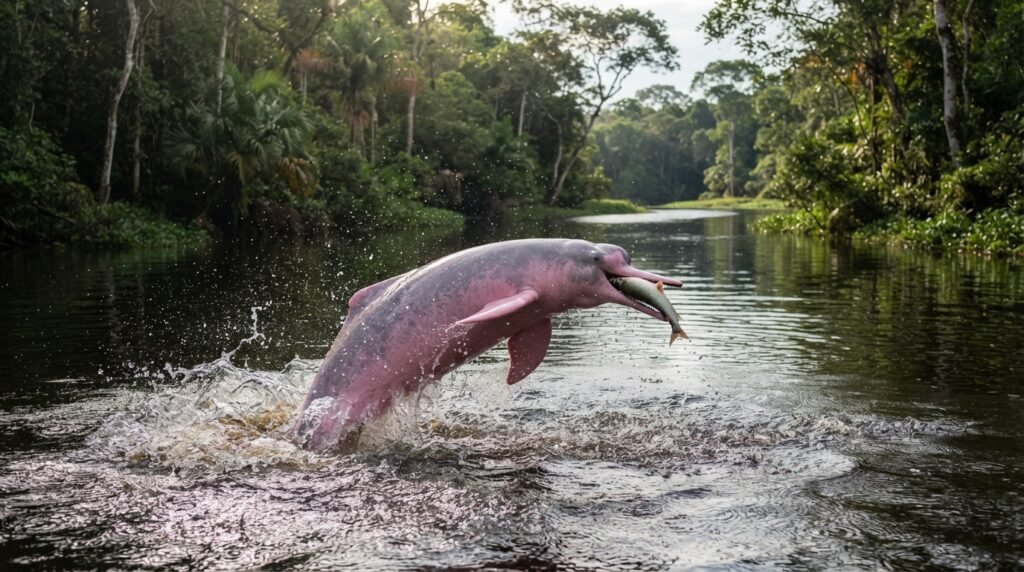
Examples of prey include:
- Croakers and catfish
- Tetras and piranhas
- River turtles
- Freshwater crabs
During the wet season, rising water spreads across forests and plains. Fish can move into these newly flooded areas, spreading prey across a larger space. Dolphins may follow food into channels and flooded woodland.
When the dry season lowers the water, many fish and other prey become more concentrated in river channels. This can make feeding areas different from those used during high water. Seasonal changes shape where a dolphin can find food.
The Amazon river dolphin is a toothed whale, and its varied diet reflects the many kinds of prey found in freshwater. Piranhas draw attention, but they are only one type of fish in the menu. Piranhas are one item in a much broader menu, not the dolphin’s only or defining food.
How Do Amazon Pink River Dolphins Live and Behave?
Amazon pink river dolphins are more often alone or in small groups than in large pods. A group commonly has just 2-4 dolphins, often a mother and her young. Their social pattern can change with age, season and local conditions.
Mothers and calves form a close bond. Pregnancy, called gestation, lasts an estimated 11 months. Births occur between May and June, and calves nurse for about a year.
A calf depends on its mother while it grows and learns. You may see the pair travel close together, even when other dolphins stay apart. These bonds explain why a small group may be a mother with one young animal.
Wild dolphins can show curiosity around boats or people, but that does not make them safe or predictable. Do not touch, feed or chase them. Close contact can stress a dolphin and can put both you and the animal at risk.
For a low-impact wildlife view, follow these practices:
- Stay with a qualified local guide.
- Keep a respectful distance.
- Follow local wildlife instructions.
Boto folklore includes stories of dolphins changing into people, sometimes at night. Some tales connect the creatures with romance, mystery or bad luck. These are cultural legends, not descriptions of animal behavior.
Curiosity does not mean a dolphin welcomes contact. Respectful viewing lets you watch natural behavior without changing the animal’s choices. Enjoy a sighting without feeding or pursuing the animal.
Are Amazon Pink River Dolphins Endangered, and What Threatens Them?
The IUCN classified the Amazon pink river dolphin as Endangered in 2018. An estimate placed the Amazon basin population at 30,000 to 45,000, but the exact number remains unknown. The species faces several pressures linked to fishing, pollution and changes to river habitat.
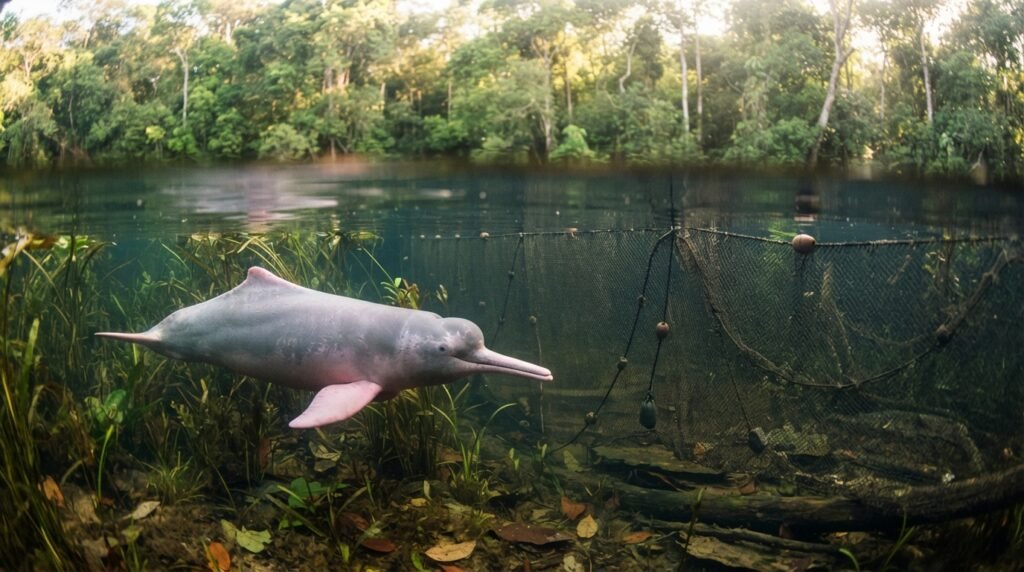
Gillnets can trap dolphins underwater and cause them to drown. Some fishers deliberately kill dolphins for bait used to catch piracatinga catfish. Overfishing can also reduce food, while boat traffic brings noise and raises the risk of injury.
Fishing, Pollution and Habitat Pressure
Illegal gold mining releases mercury, which can enter rivers and move through the food chain. Dolphins can build up mercury in their bodies. The metal can harm the nervous system and reproduction.
Dams can block travel routes and split habitat into smaller sections. Prolonged drought and habitat loss can reduce access to suitable waters and prey. Each pressure can add to risks from fishing and pollution.
| Threat | How it harms dolphins | Concrete example |
|---|---|---|
| Gillnets | Drowning | Trapped underwater |
| Piracatinga bait hunting | Deliberate killing | Dolphins used as catfish bait |
| Illegal gold mining | Mercury enters the food chain | Mercury can build up in dolphins |
| Dams | Block routes and fragment habitat | River sections become cut off |
| Drought and habitat loss | Reduce access to habitat and prey | Low water limits suitable areas |
Conservation Status and What Protection Involves
A population viability study projected a 95% loss within 50 years if current mortality rates continue. The projection drew on monitoring in Brazil’s Mamirauá Sustainable Development Reserve. It describes a risk under a stated condition, not a certain outcome.
In a 2025 health-check operation, a captured dolphin could safely remain out of water for only 15 minutes. Tested dolphins had 20 to 30 times the cited maximum mercury level of 1 milligram per kilogram. A conservation team had previously found levels of 16 to 18 milligrams per kilogram.
Protection can include safer fishing practices, limits on deliberate killing and efforts to reduce mercury pollution. River planning also matters when dams or drought change how dolphins reach habitat. Mercury measurements and a conditional population projection describe serious pressures, not a guaranteed future outcome.
Are Pink Dolphins Found in the United States?
Yes, pink-looking dolphins have been seen in the United States, but they are not Amazon river dolphins. Pinky, a bottlenose dolphin in Calcasieu Lake, Louisiana, has a pinkish-white appearance linked to suspected albinism. The U.S. sightings involve a marine dolphin, not the South American freshwater species.
Albinism reduces normal pigment and may make skin look pale or pink. Reddish eyes and visible blood vessels can be signs of the trait. Those visible clues do not prove albinism; genetic testing is needed to confirm it.
A dolphin’s color alone cannot tell you which species you are seeing. Habitat and body traits help separate a freshwater river species from a marine animal. The Chinese white dolphin is another animal sometimes called a pink dolphin.
| Animal | Usual habitat | Why it may be called pink | Identification clue |
|---|---|---|---|
| Amazon river dolphin | South American freshwater rivers | Natural age-related pink coloration | River species |
| Albino bottlenose dolphin | Coastal marine waters | Albinism | Pinkish-white skin and reddish eyes |
| Chinese white dolphin | Coastal waters of Southeast Asia | Alternate pink-dolphin name | Also called the Chinese white dolphin |
Pinky is a well-known Louisiana example, but one dolphin does not represent the Amazon species. A pale or pink appearance can have different causes in different animals. Scientists need genetic evidence to confirm albinism rather than relying on skin or eye color alone.
The name pink dolphin may refer to a river species, an unusually pale bottlenose dolphin or the Chinese white dolphin. These animals differ in their habitat and biology. Identify the animal by its species and habitat, not by pink color alone.
Conclusion
The Amazon river dolphin is both a striking animal and a species whose future depends on healthy rivers. Its pink color develops with age, and its freshwater home sets it apart from other pink-looking dolphins. Knowing that difference helps you make sense of sightings and conservation news.
Before planning a wildlife encounter, learn from a qualified local naturalist or conservation organization. Choose an operator who follows local wildlife rules and keeps dolphins free to move away. Choose a reputable conservation organization to learn how river protection supports the dolphins and the wider Amazon ecosystem.