
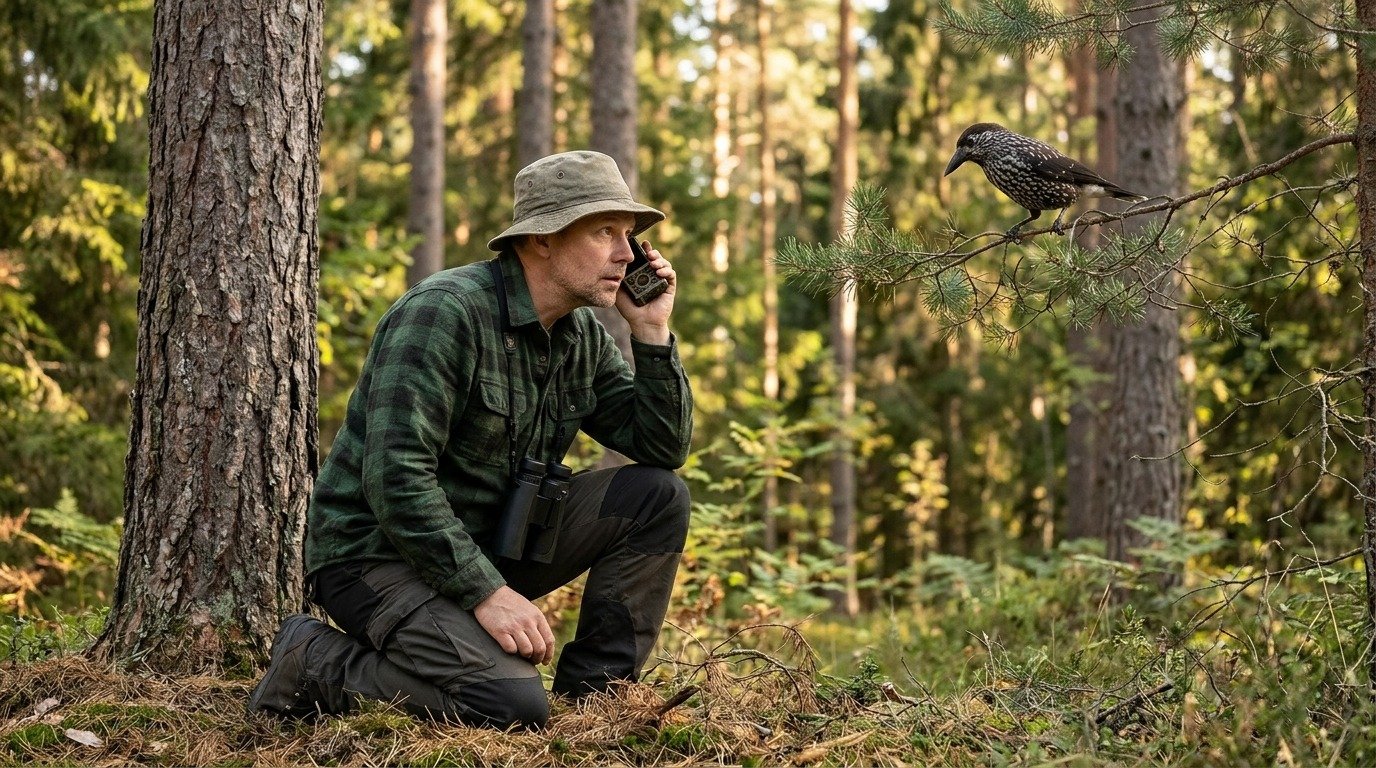
You can identify a Spotted Nutcracker more confidently by its call pattern and context than by written imitation alone. A call may stand out while you watch birds, yet wind or distance can blur its shape. One spelling cannot capture every detail your ear detects.
Subsong is a quiet, song-like vocalization made up of squeaky, harsh, twittering sounds. This online sound guide helps you match a field recording to the birdwatching scene around it. You will get the main sound clues, practical checks, and sample recordings for comparison.
A clear pattern can narrow your choices, while the setting helps prevent a guess based on one note.
Key Takeaways
- Use the call pattern as a clue, not a stand-alone answer.
- Compare full recordings rather than spellings alone.
- Check the bird’s location and habitat.
- Save observation details with your own audio.
Use the guide to compare what you hear with recorded examples, then keep the observation details with your own recording.
Spotted Nutcracker Bird Sound: What Does It Sound Like?
A long, rough note that rolls at an even pitch is a useful first clue. The loud call is harsh and often comes in repeated notes.
The loud, repeated call
The common call is a dry, harsh “krraaaaaak.” A characteristic call sounds like a hard, rolling “krrrrreh,” often repeated a few times rapidly.
Its pitch stays even, giving the sound an almost machine-like quality. The characteristic call is longer, feebler, and higher in frequency than a Hooded Crow’s usual call.
The Northern Nutcracker, also called the Eurasian Nutcracker, has a loud, harsh voice somewhat like a Eurasian Jay’s. It sounds slightly lower-pitched and more single-toned, often rendered “kraak-kraak-kraak-kraak.”
The nutcracker Nucifraga caryocatactes is the spotted nutcracker discussed here. The name Nucifraga caryocatactes also appears in sound identification searches as nutcracker Nucifraga.
Call spellings can help you recall a sound, but they cannot show every detail of its pitch or tone. A dove call comparison offers another example of hearing a pattern alongside other clues.
| Sound type | Rendering or quality | Distinguishing clue |
|---|---|---|
| Common harsh call | krraaaaaak, dry and harsh | Common call |
| Characteristic call | krrrrreh, hard, rolling, even-pitched | Longer, feebler, and higher-frequency than a Hooded Crow’s usual call |
| Soft notes | yaik and kya | Jackdaw-like |
| Subsong | squeaky, harsh, twittering | Quiet and seldom heard |
Softer calls and rarely heard subsong
Soft notes include Jackdaw-like “yaik” and “kya” sounds. You may also hear squeaks, whistles, or yelping sounds.
Whistles range from whining notes to purer, more focused tones. Softer, song-like sounds likely serve a role like song in other corvids, and birds usually use them during breeding.
A seldom-heard song takes the form of subsong. Advertising calls can signal a bird’s presence, mate-seeking, or territorial defense, and the same call can serve either purpose.
Across the caryocatactes group, these sounds offer useful clues without making written spellings exact measures. Treat the written syllables as memory aids, not exact sound measurements.
Can You Identify a Spotted Nutcracker by Sound Alone?
A call can make an identification plausible, but sound alone should not establish a subspecies. Check the complete recording and the bird’s geographic context before settling on a name.
Listen to the whole recording
A full phrase gives you more than one isolated sound to assess. Listen for other vocalizations in the same recording, since they add context to the bird’s call.
Use this short checklist when you review an audio clip:
- Listen to the full phrase rather than an isolated syllable.
- Note whether other vocalizations occur in the same recording.
- Record the broad location and habitat.
These details support sound identification, but they do not prove which subspecies made a call. A recording’s setting can help you judge whether the name fits the place.
Use geography to check the name
The Northern Nutcracker, Eurasian Nutcracker, and Spotted Nutcracker are common names for Nucifraga caryocatactes. Its breeding region stretches across Eurasia, from Europe to northeastern Japan.
Four subspecies are listed. Nucifraga caryocatactes caryocatactes breeds in Europe, while N. c. japonica breeds in the Kuril Islands and northern Japan.
Nucifraga caryocatactes macrorhynchos ranges from the Ural Mountains to eastern Siberia and northeastern China. N. c. rothschildi ranges from Kazakhstan to northwestern China.
The Avibase taxonomic profile lists these names and ranges. Geography can help you choose a suitable common name, but it cannot assign a call to one subspecies.
If the sound and location point in different directions, keep the identification tentative until you can verify the bird visually or with a trusted local checklist.
Where Can You Hear More Nutcracker Recordings?
The two sample recordings give you different lengths to compare, one 0:22 and the other 0:09. Those times describe the clips, not the length of a single call.
Both recordings are credited to Zdeněk Vermouzek and Jan Cibulka, and both use a CC BY-SA license. Their streaming copies are transcoded to 96 kbps mono, meaning one audio channel at a data rate of 96 kilobits per second.
The larger Xeno-canto collection lists 512 Spotted Nutcracker recordings. You can use its range of clips to hear more examples and compare how different recordings capture the species.
When saving a clip, retain its credit and license details with the audio. Keep each sample’s label and recording length attached if you save it for later comparison.
Conclusion
A careful sound identification comes from matching more than a written call spelling. The call pattern is a helpful clue, while context makes your identification stronger. A spelling can suggest what to listen for, but it cannot capture every detail in a field recording.
For your next bird observation, note what the bird was doing and what was nearby. Those details can help you judge the sound again later, even when the recording is brief or unclear.
For your next bird observation, keep a brief field note alongside the audio so you can revisit the identification later.
FAQ
Why are Spotted Nutcracker calls written with different spellings?
Different spellings approximate the sounds people hear; they do not always mark separate call types. A written syllable cannot capture every shift in pitch, tone, or timing. Compare the audible pattern instead of treating each spelling as a new call. Listening to a full phrase can also reveal more than one short written imitation.
Does a 0:09 sample mean the bird’s call lasts nine seconds?
No, 0:09 gives the recording’s full length, not the duration of one call. A clip can hold a call and the quiet around it, or include more than one sound. Treat the time as a label for the audio file. It does not measure how long the bird vocalized.
What does 96 kbps mono mean in a bird recording?
Mono means the recording plays through one audio channel, while 96 kbps describes the streaming copy’s data rate. The rate tells you how much audio data the stream carries each second. It does not show how long the bird called. The sample’s playback time gives the clip length instead.
Can you reuse a CC BY-SA recording in a school project or podcast?
Yes, you can reuse a CC BY-SA recording if you follow the specific clip’s license terms. Credit the named recordists, and check the share-alike rules before adapting the audio. Those rules may apply to a changed version you share. Keep the credit and license details with the file as you prepare your project.
How can you make a field recording easier to identify?
Capture the full vocal phrase without clipping its start or end, and reduce nearby noise where possible. Also note the date and broad location while the details are fresh. A short field note can record habitat or nearby sounds. Together, those details give you more context when you later review the audio.