
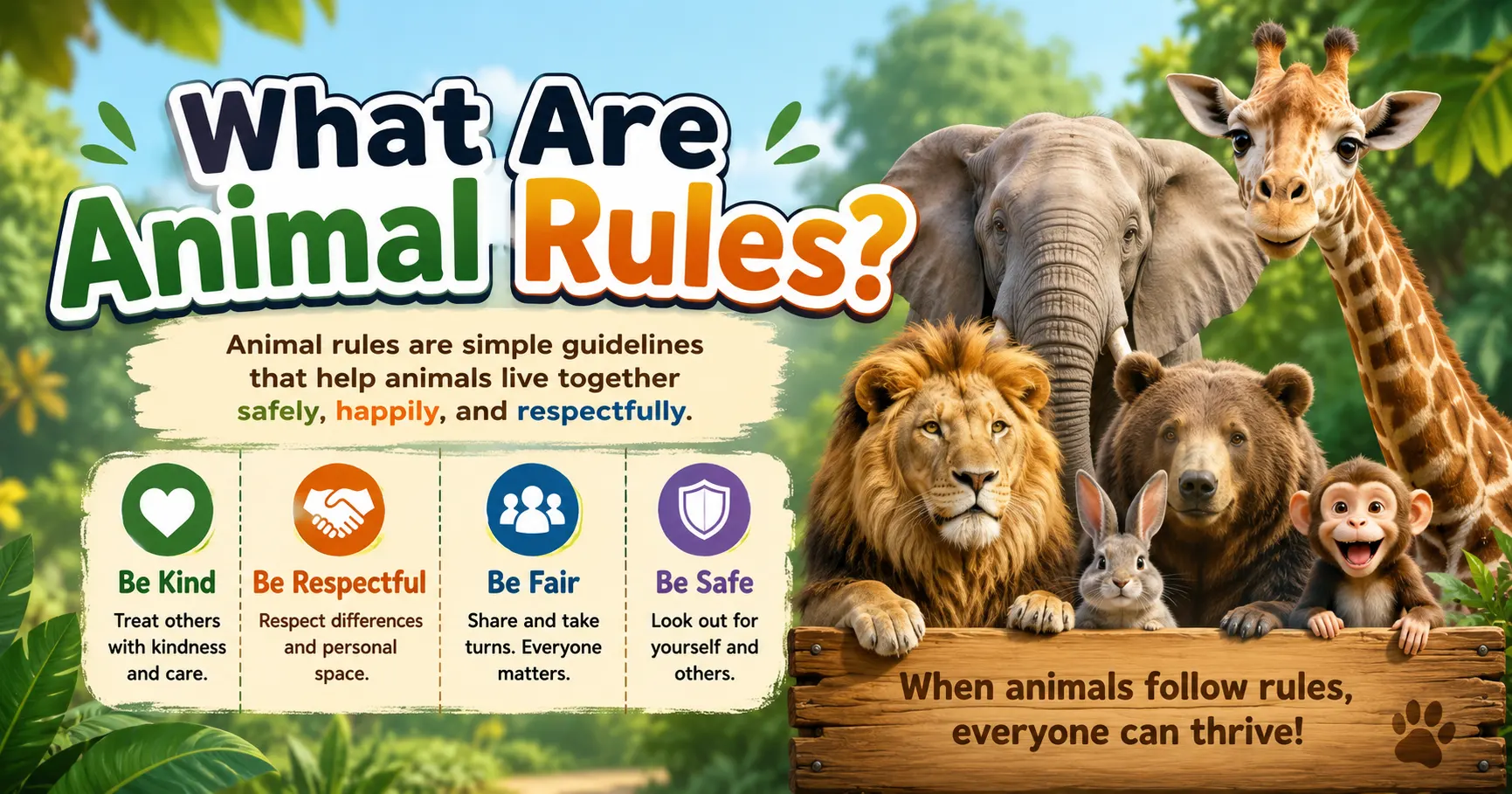
Animal rules are not written laws. The phrase describes the patterns of behaviour that help animals survive, find food, raise young, and live together. Each pattern exists because animals that behaved this way left more offspring than those that did not. This guide explains the main animal rules, from camouflage and energy saving to territories, hierarchies, and cooperation, with examples you can check.
What Are Animal Rules?
Animal rules are repeated behaviours shaped by natural selection over millions of years. Animals do not follow them by choice or understand them in a human way. A bird migrates, a wolf cooperates with its pack, and a bee dances because those behaviours improved survival and reproduction in the past.
- Wolves hunt in coordinated groups
- Many birds migrate with the seasons
- Honeybees communicate food locations with a waggle dance
- Emperor penguins share the work of raising chicks
- Elephants live in family herds led by older females
Rule 1: Survival Comes First
An animal must stay alive long enough to reproduce, so much of its behaviour is about finding food and avoiding danger.
Camouflage
Camouflage lets an animal blend into its background to hide from predators or surprise prey. Leaf insects look like leaves, Arctic hares turn white in winter, and many animals stay perfectly still because movement gives them away.
Mimicry
Mimicry is when one species resembles another to avoid being eaten. The viceroy butterfly is a famous example. It looks like the monarch and the queen butterfly. Textbooks once called it a harmless fake, but a 1991 study in Nature found that viceroys are bitter-tasting too, so both butterflies share a warning pattern. Later research found that the viceroy’s distaste can vary depending on how common the queen butterfly is where it lives. The story shows that nature’s rules are often more complicated than they first seem.
Defensive Strategies
- Playing dead, as opossums do
- Releasing chemicals or toxins
- Making the body look larger
- Warning sounds, such as a rattlesnake’s rattle
For a closer look at one defence strategy in action, see our comparison of cobra vs peacock.
Rule 2: Save Energy When Possible
Moving, hunting, and migrating all use energy, so animals tend to avoid wasted effort.
Efficient Hunting
Predators often go after prey that is easier to catch, such as young, old, or injured animals. A failed chase costs energy, so a cheaper target is a better bet.
Rest and Sleep
Resting is another way to save energy. Lions sleep roughly 16 to 20 hours a day, koalas sleep around 18 to 22 hours, and opossums about 18. Sloths are often called the sleepiest animal, but a study of wild sloths found they averaged only about 9.6 hours a day, compared with 16.4 hours in captivity.
Rule 3: Reproduce and Raise Young
Survival matters because it gives an animal the chance to pass on its genes.
Courtship Displays
Many species use displays to attract a mate: peacock tails, birdsong, frog calls, and the antler contests of deer. These signals show strength and health.
Parental Care
Some animals invest a lot in their young. Elephants care for calves for years, wolf packs help raise pups, and penguins share incubation duties. In 2026, the birth of an elephant calf at a US zoo showed how a herd can step in when a mother needs help: read about Asian elephant Linh Mai.
Rule 4: Defend a Territory
Many animals defend an area that holds food, shelter, water, or breeding sites. Tigers, eagles, and songbirds all do this. Most territorial disputes are settled with displays rather than fights, which lowers the risk of injury.
- Roaring and calling
- Chest beating
- Wing spreading
- Scent marking
Rule 5: Live in Groups When It Pays
Group living gives animals more eyes to watch for predators, a better chance of finding food, and help with raising young.
- Wolf packs: usually a breeding pair and their offspring, which hunt large prey together, defend territory, and raise pups. Learn how to tell wolves apart from similar animals in our guide to coyotes and wolves.
- Elephant herds: led by older females, with family bonds shaping daily life.
- Ant colonies: workers, soldiers, and queens each have specific jobs.
Rule 6: Order Reduces Conflict
Many social animals form dominance hierarchies, which settle who gets first access to food or mates without constant fighting. The “pecking order” comes from chickens, where each bird knows which others it can peck and which it must avoid. Primate groups often show similar ranks. Hierarchies are not always fixed: in many wild groups, status shifts with age, family ties, and alliances.
Rule 7: Cooperate When It Pays
Nature involves competition, but also cooperation when the benefits outweigh the costs.
Cooperative Hunting
Wolves, orcas, lions, and dolphins hunt in groups, which can allow them to take prey larger than a single animal could manage.
Mutualism
In mutualism, both partners benefit. Cleaner fish remove parasites from larger fish at cleaning stations, and bees get nectar while pollinating flowers. Oxpeckers are often given as a mutualism example, eating ticks from large mammals, though some evidence suggests they may also feed on blood and wounds, so the relationship is not purely friendly.
Rule 8: Adapt or Decline
Environments change, and species that cannot adapt may decline or disappear.
- Physical adaptations: polar bear insulation, camel water conservation, owl night vision
- Behavioural adaptations: migration, hibernation, seasonal breeding, food storage
Rule 9: Predators and Prey Stay in Balance
Predators influence prey numbers and behaviour, and prey influence predators in return. Wolves can affect where deer graze, owls keep rodent numbers in check, and sharks help keep fish populations healthy. When a top predator disappears, other species can boom or crash, though the exact effects vary from one ecosystem to another.
Related Reading on Pets News Life
- Are Animals Smarter Than Humans? Fascinating Facts About Animal Intelligence
- 7 Key Causes of Squirrels ‘Near Extinction’ and How to Save Them
- Groundhog Day and Extinct Animals: What This Tradition Teaches Us
External Resources
- Nature: The viceroy butterfly is not a Batesian mimic
- ScienceDaily: Mimicry in viceroy butterflies depends on the abundance of the model
- Animal Diversity Web: Viceroy (Limenitis archippus)
- Pecking order (Wikipedia)
Conclusion
Animal rules are patterns that evolution has shaped over millions of years: stay alive, save energy, raise young, hold territory, live in groups, cooperate, adapt, and keep the food web in balance. They are not rigid laws, and many have exceptions, but they explain a lot about how animals behave and why protecting their habitats matters.
FAQs
1. What are animal rules?
They are behaviour patterns shaped by evolution that help animals survive and reproduce. They are not rules in a legal sense.
2. Why do animals live in groups?
Groups give more protection from predators, make hunting or foraging easier in some species, and let adults share care of young.
3. Do animals have social hierarchies?
Many do, including chickens, primates, and some wolf and elephant groups, though the structure varies and often depends on age, family, and alliances.
4. Why is communication important in animals?
It lets animals find mates, warn of danger, mark territory, and coordinate with their group, using sounds, scents, and body language.
5. How do animals adapt to changing environments?
Over generations, traits that help survival become more common. In the short term, animals can also change behaviour by migrating, hibernating, or switching foods.
6. Are animal behaviours learned or instinctive?
Both. Some behaviours are inborn, while others are learned from parents, other group members, or experience.
7. What can humans learn from animal rules?
They show how cooperation, communication, and adaptation help groups survive, and why protecting ecosystems matters for all species, including ours.
3 thoughts on “Animal Rules: Understanding the Natural Laws That Govern Animal Behaviour, Survival, and Social Life”