
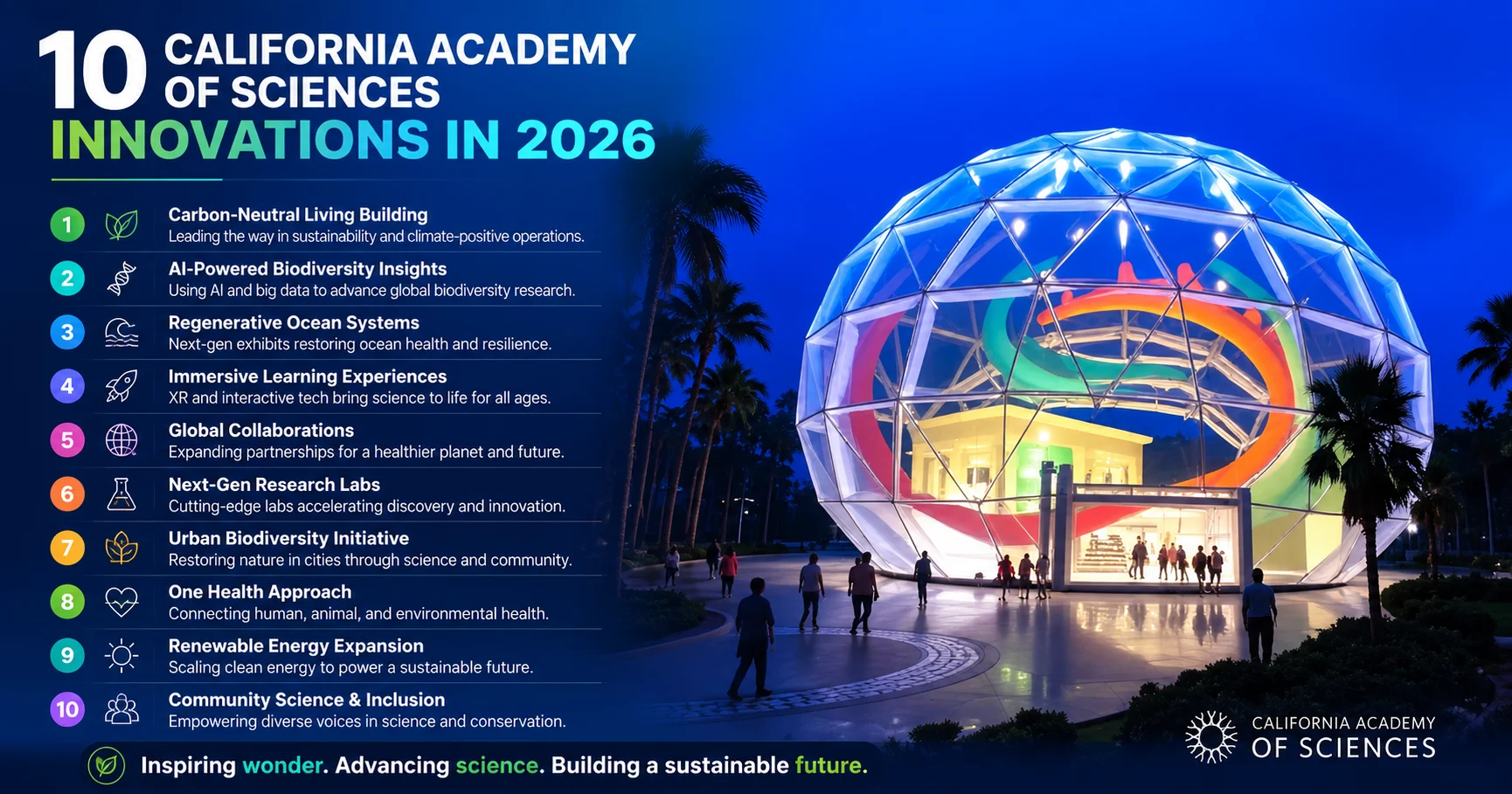
The California Academy of Sciences in San Francisco’s Golden Gate Park is an aquarium, planetarium, natural history museum, and research institution under one roof. This guide covers 10 California Academy of Sciences innovations in 2026, from a sensory exhibit to new species discoveries. Not every item launched this year: some are long-running programs that made headlines in 2026, and we say so where that applies.
About the California Academy of Sciences
Founded in 1853, the Academy cares for around 46 million specimens and employs more than 100 scientists, according to its own 2026 species announcement. Its research covers many fields.
- Marine biology and ichthyology (fish)
- Botany and entomology
- Invertebrate zoology and herpetology
- Ornithology and paleontology
- Conservation and biodiversity science
10 California Academy of Sciences Innovations in 2026: Quick List
- Vivid: Immerse Your Senses, a multisensory exhibit
- 72 new species described in 2025 and announced in January 2026
- New sea slugs from the Indo-Pacific and California
- A new sunflower genus from Texas
- New reef fishes, including a perchlet from the Maldives
- Twilight-zone reef discoveries near Guam
- A global report on new freshwater fish species
- Community science through iNaturalist
- The living roof and sustainable building design
- Public exhibits that make science accessible
1. Vivid: Immerse Your Senses
Vivid: Immerse Your Senses was a new multisensory exhibit that ran from May 22 to September 6, 2026, in the Academy’s Forum Gallery, as stated in the Academy’s press release. It was a North American tour co-produced by Supply + Demand and presented with the Academy. The exhibit has now closed, so check the Academy’s website for what is on view.
It used high-resolution video projection, spatial audio, and nature-inspired scents to place visitors inside six ecosystems. These included a rainforest canopy, a bat cave, a prairie, an underground habitat, ice floes, and the ocean depths where whales swim.
2. 72 New Species Described in 2025
Academy researchers and collaborators described 72 new animal, plant, and fungus species in 2025, announced on January 7, 2026. The discoveries came from six continents and included a bird, fish, plants, sea slugs, and insects, as reported by Mongabay. Academy scientists have said that only a small fraction of Earth’s species is known to science, so each description helps fill in that picture.
3. New Sea Slugs
Invertebrate zoology curator Terry Gosliner described 11 sea slugs in 2025. They included Cyerce basi, an opalescent sea slug from the Indo-Pacific, and Doto kwakwak, a California sea slug named with the Kumeyaay word for “yellow.”
4. A New Sunflower Genus
The “wooly devil” (Ovicula biradata) represents a new genus and species in the sunflower family, found in Texas. A new genus is a bigger scientific step than a new species alone.
5. New Reef Fishes
Ichthyology curator Luiz Rocha described Plectranthias raki, a colorful perchlet from the Maldives. The 2025 list also included four goby species, one of which, Eviota vader from Papua New Guinea, was named after Darth Vader.
6. Twilight-Zone Discoveries Near Guam
Academy scientists found 20 new species in deep reefs in the Pacific twilight zone near Guam. The work also found evidence of ocean warming at those depths, reported at the end of 2025. Deep reefs are hard to reach, so each survey adds data that surface reefs cannot provide.
7. A Global Report on Freshwater Fish
A report released in March 2026 by SHOAL, the IUCN Freshwater Fish Specialist Group, and the California Academy of Sciences counted 309 new freshwater fish species described in 2025. That works out to almost one a day.
8. Community Science and iNaturalist
The Academy works with the public through community science. One of the 2025 species, a California cicada, was documented through iNaturalist observations. The Academy also helped launch the City Nature Challenge, where people around the world record local wildlife.
- Everyday observers add records that scientists can use
- Large datasets help track where species live
- Participation builds public interest in local nature
9. The Living Roof and Sustainable Design
The Academy’s building is known for its living roof of native plants, which supports habitat and helps manage heat and stormwater. It is not new in 2026, but it remains one of the museum’s best-known examples of design that works with nature.
10. Exhibits That Make Science Accessible
Beyond special exhibits, the Academy’s permanent galleries include California: State of Nature, an interactive exhibit about the state’s ecosystems, and live animal habitats such as the aquarium and rainforest. These displays turn research into something visitors can see and touch.
Challenges Ahead
- Funding for large research programs and collections
- Biodiversity loss and climate change, which threaten the species being studied
- Keeping exhibits and research tools up to date
Related Reading on Pets News Life
- CT Scanner Used for the First Time at a Norfolk Zoo
- Endangered Deer Species: Conservation Efforts and Challenges
- Rare Mexican Axolotl: Complete Guide
External Resources
- California Academy of Sciences: 72 new species in 2025
- Vivid: Immerse Your Senses press release
- Mongabay: From sea slugs to sunflowers
Conclusion
From the Vivid exhibit to dozens of newly described species, the Academy’s 2026 stands out for how it joins research with public engagement. Large collections, field expeditions, and community science all feed the same goal: understanding life on Earth well enough to protect it.
FAQs
What were the main California Academy of Sciences innovations in 2026?
Highlights include the Vivid: Immerse Your Senses exhibit, the announcement of 72 new species described in 2025, deep-reef discoveries near Guam, and a global report on new freshwater fish.
Is the Vivid exhibit still open?
No. It ran from May 22 to September 6, 2026. Check the Academy’s website for current exhibits.
How many specimens does the Academy hold?
About 46 million, according to the Academy.
Why is discovering new species important?
It helps scientists understand ecosystems and decide which habitats and species most need protection.
Can the public take part in Academy research?
Yes. Community science programs such as iNaturalist and the City Nature Challenge let people record wildlife that scientists can use.
Where is the California Academy of Sciences?
In Golden Gate Park, San Francisco, California.
5 thoughts on “10 California Academy of Sciences Innovations in 2026: Transforming Science and Conservation”