Introduction: Facts about animal emotions
Earlier presumed that only humans can feel emotions. Instinct ruled animals, people said – they just responded to what happened around them, never truly feeling anything real. Now, research paints another picture altogether.
Back at the lab, scientists digging into how creatures act noticed something big – feelings show up in all sorts of species. When a person walks through the door, the dogs bounce like they’ve won a prize. Over by the savannah, elephants stand quietly near fallen kin, heads low, moving slowly. Far out in deep water, dolphins nudge hurt pod mates toward safety. Meanwhile, chimps will wrap an arm around another chimp trembling in sadness. Turns out, emotional life might stretch across beasts much further than anyone once figured.
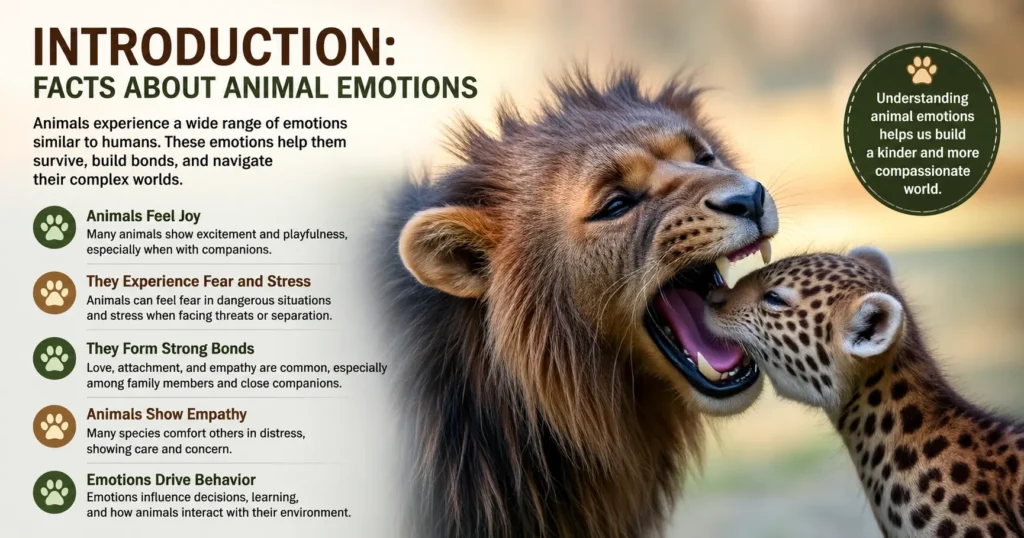
Because we care about how creatures feel, better choices get made. When feelings matter, protection plans work harder. Trust grows where people notice moods in beasts. Hidden clues about emotional roots show up in their behavior. What they experience reveals older stories than we thought.
Here’s something odd – creatures big and small might feel more than we think. Picture a crow holding a grudge, then pause. Scientists have caught wolves showing worry when packmates vanish. Joy pops up too, like dolphins spinning for no reason except maybe delight. Grief slips in quietly, seen in elephants standing guard over bones. One study shows rats freeing trapped friends, not for reward but perhaps because it matters. Warmth between mothers and young stretches across species, slow and steady. Even pair bonds in birds hint at something close to what humans call love.
Animal Emotions Explained?
Fear can shape how a creature reacts when danger appears. Inside every living thing, feelings guide choices without words. A sudden noise might send one running, another freezing – mood steers motion. What an animal feels colors its next move, quiet or bold.
From deep within biology, feelings shape how creatures adjust to where they live. When a fox smells smoke, fear pushes it away – instinct guiding motion before thought arrives. Connection grows between pups and parents, not by choice but through quiet nudges of need. Hunger for safety pulls some toward shelter; others follow joy into open fields. Moments like these build up to survival , small twitches with long aftershocks. “Even when the animals are silent,” scientists can “hear” what they are feeling by “reading” them, through close analysis of behavior and physiology.
Behavioral observations
- Brain imaging studies
- Hormone measurements
- Facial expressions
- Vocalizations
- Social interactions
- Physiological changes
Funny how feelings aren’t just a people thing – more studies now show creatures big and small react with moods much like ours. Emotions help them survive, kind of how sadness or joy guides us. Turns out fear keeps a deer alert, just as it sharpens our focus when danger’s near. Even joy shows up in playful pups, not so different from kids laughing on swings. What feels personal to humans appears woven into animal lives, too.
Emotions Shape Life in Nature
Funny thing – emotions go way beyond just how you feel. “It would be so much harder to stay alive or have kids without them.
Survival Benefits”
Fear helps animals avoid predators.
Fear of the unknown often slows your steps. Sometimes hesitation keeps you safe when things feel off.
Fighting back might guard a space, a meal, or young ones.
Social Benefits
Many species rely on cooperation.
Fear fades when shared, because laughter builds bridges between people. Trust grows not in silence but through small moments that connect us. Stability finds its roots where feelings are allowed to show, not hidden away.
Parenting Benefits
Baby animals stand a better chance when their bond with parents runs deep. Close ties often mean more protection during tough moments. Because trust forms early, responses to danger become quicker. When young ones feel safe, they explore without drifting too far. This kind of attachment guides them through critical growth phases. Survival climbs where emotional links are solid.
Learning Benefits
How creatures grow smarter often ties back to moments that go well, as well as times filled with struggle. A stumble today shapes a sharper move tomorrow, while success plants quiet clues for later choices.
Dogs Feel Real Happiness
Fur coats thump tails when joy sparks behind their eyes. The most clear signs of happy feelings in creatures come from dogs.
Some folks who live with dogs notice actions that seem full of joy and energy
- Tail wagging
- Jumping
- Playfulness
- Joyful greetings
- Relaxed body language
The Science of Dog Happiness
When dogs interact well with people, their brains release more dopamine – a similar rise shows up in oxytocin levels too. A boost in these chemicals appears after moments of connection, like petting or play. Moments of closeness spark changes deep inside their nervous system. These shifts mirror what happens in humans during bonding experiences. Brain activity responds strongly when trust builds between species.
There’s oxytocin quietly at work behind the scenes when two people feel bonded in one way or another. This chemical is elevated in times of trust – as if during a long hug or while holding hands. It shows up most when laughter lingers between friends. Even small gestures – like a gentle touch – can stir its presence. Close bonds tend to grow where it flows freely.
Oxytocin rises in both dogs and people during loving moments between them. A shared glance or gentle touch can spark this shift. Not just one side feels it – both do. Warm contact nudges chemistry in a similar direction for each. Even brief exchanges hold weight here. The bond shapes biology without needing words. Out of nowhere, a shared heartbeat seems to pulse between people and their dogs. That quiet moment when eyes meet? It’s biology leaning in. Chemical signals slip through the air, stitching closeness without words. A dog’s gaze can trigger soft shifts inside us – unplanned, unnoticed. These tiny reactions build something steady over time. Not magic, just molecules mapping trust. Connection grows where attention lands.
Elephants May Mourn Their Dead
Surprisingly deep feelings show up in elephants, say researchers who watch animal behavior closely.
Beyond just observation, signs of sorrow show up again and again among animals. Noticing loss seems woven into how some creatures respond when others disappear.
Observed Mourning Behaviors
Elephants often:
- Stay close to loved ones after they have passed away
- Touch bones with their trunks
- Show unusual silence
- Return to locations where companions died
These behaviors suggest emotional responses that extend beyond simple curiosity.
Strong Family Connections
Born into tight bonds, elephant groups stick together through years of change. Long after calves grow strong, they still travel beside their kin. Shared memories guide them across wide lands, season after season.
A single absence might shift how others move together, months slipping by without changing that quiet pull. How one departure echoes through shared steps, seasons passing, the pattern yet holds. Even later days carry traces of who once walked among them. Distance grows, but the group still moves as if someone were there.
Chimpanzees Feel What Others Feel
Most of a chimpanzee’s genetic code looks almost like ours.
It makes sense that their feelings often look a lot like ours.
Examples of Empathy
Chimpanzees often:
- Comfort distressed individuals
- Share food
- Help injured group members
- Reconcile after conflicts
Noticing how someone feels shows you’re tuned in. Paying attention to mood shifts helps make sense of reactions. Reading the room often means catching quiet signals. Understanding glances can reveal more than words. Responding gently suggests empathy is at work.
Why Empathy Matters
When people understand each other, working together gets easier. Tension between them tends to fade at the same time.
Maybe it helped shape how intricate social circles came to be.
Rats Assist Fellow Rats
It turns out rats show something strange when scientists watch them closely.
A rat would help another escape, though nothing came of it. Sometimes they moved straight to free a cage-mate without stopping. The act happened again and again, even with no treat nearby. Helping unfold whether or not anything changed afterward. A trapped rat drew effort from others regardless of the outcome.
Experimental Findings
In controlled studies:
- Rats learned how to open restraining devices.
- They repeatedly freed trapped companions.
- A few bites passed around later.
Surprising actions spotted in creatures that people rarely give credit could point to something close to human empathy. A second look at their reactions shows patterns that mirror how we connect emotionally – just slower, quieter. Not every silent moment means there is none; sometimes it hides in plain sight.
Dolphins Show Emotional Awareness
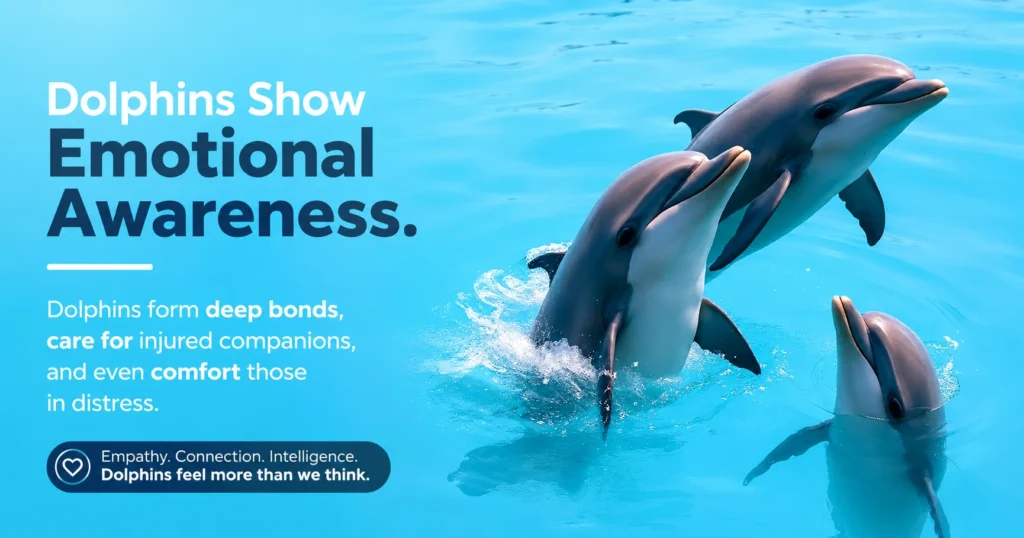
Of all the creatures on Earth, the dolphin holds its head high when it comes to having an unusually large brain for its body size.
They demonstrate:
- Cooperation
- Playfulness
- Problem-solving
- Social bonding
- Helping behaviors
Assisting Injured Dolphins
One moment, a dolphin will be seen pushing another up through the water. Sometimes they nudge their companions gently toward sunlight and air. Moments like these show how one animal stays close when another struggles to rise. Breathing becomes easier because someone helps without being asked. You might notice how bodies move together in slow motion. Not every action needs a reason when survival is quiet and shared.
These moves show a deep sense of how people interact.
Long-Term Friendships
Years stretch out behind some dolphins as they hold close bonds. Behind every group lies a web built slowly, held together through time. Bonds between friends can shape how long someone lives, also affecting their chances of having children.
Birds Feel Strong Emotional Connections
Beyond what most assume, birds feel deeply. Their emotions run wider than common belief allows.
Species known for strong social bonds include:
- Parrots
- Ravens
- Crows
- Swans
- Cockatoos
Lifelong Partnerships
Some birds stick together for years, sometimes their whole lives. A few stay paired up long term, others part ways after seasons pass. Together they raise chicks, then maybe separate when days grow short. Bonding happens differently across kinds, yet many choose one mate again and again.
Partners cooperate in:
- Nest building
- Raising offspring
- Defending territory
- Finding food
Separation from a bonded partner can lead to noticeable behavioral changes.
Animals Are Afraid Too
Fear, after all, is the one true universally experienced emotion in nature.
Fear is an animal’s friend in life-threatening situations.
Common reactions include:
- Freezing
- Running away
- Hiding
- Defensive aggression
- Increased alertness
Evolutionary Importance
Fleeing danger poorly? That cuts survival odds before mating even enters the picture.
Fear still stands as a key survival tool shaped by time. Though often uncomfortable, it guides reactions without needing thought. Built into responses over ages, it acts before logic steps in. When danger appears, this instinct moves faster than reasoning ever could.
Play Shows Positive Feelings
Bouncing around happens across creatures everywhere.
Play tends to show up when animals feel good, researchers notice. A bounce in movement might mean joy inside. Watching how creatures interact can reveal inner feelings clearly. Moments of chasing or leaping carry hidden clues about mood. What looks like fun may actually signal well-being underneath.
Animals That Play
- Dogs
- Wolves
- Dolphins
- Bears
- Primates
- Ravens
Benefits of Play
Play helps develop:
- Social skills
- Physical coordination
- Ability to problem solve
- Emotional toughness
Puppies tumble through grass not just as a game, but their wild stops and starts teach them balance they’ll need later. Chasing each other builds speed, useful when escaping danger as grown creatures. Mock fights sharpen skills that future survival depends on. Leaping at leaves improves the coordination required for real hunting. Even clumsy climbs strengthen muscles used in climbing trees or rocks one day. Playtime looks like joy – it is also quiet training.
Animals Have Unique Personalities
Animals, like people, are emotionally unique creatures. Emotion Researchers have found personality traits in many species.
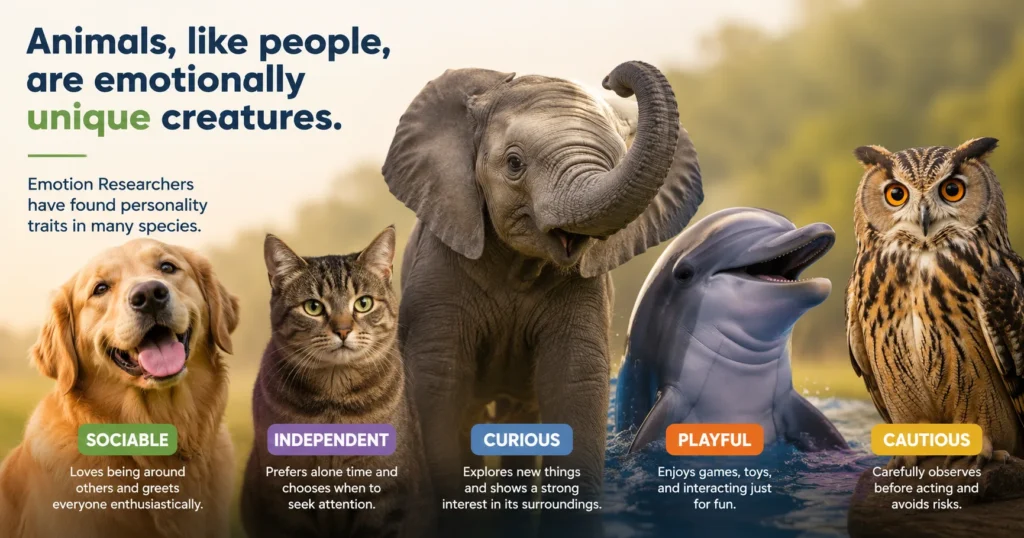
Traits commonly include:
- Boldness
- Curiosity
- Aggressiveness
- Sociability
- Patience
- Shyness
These differences influence how animals respond emotionally to situations.
Mother and Child Connections Are Very Strong
Parental care depends heavily on emotional mechanisms.
Offspring often stick close to parents because that bond helps them last longer and grow stronger. Not every animal does it quite this way, yet most find that some kind of connection matters deeply. From start to finish, the care shown early shapes how well they handle life ahead.
Examples across Species
Elephants protect calves for many years.
Orcas teach hunting techniques to their young.
Young primates take a long time to grow up because their parents care for them deeply over many seasons.
Baby birds get food nonstop, while parents stay alert against threats. Protection comes just as often as meals do. Each day repeats this way without slowing down.
Not just gut feelings shape these bonds. Scientists think feelings drive the effort parents put into raising kids.
Separation Distress
When baby animals lose touch with their moms, they often act upset. Sometimes they cry or move around too much. A few just freeze in place, quiet but tense. Others search nonstop, calling out into the air. Some shake slightly while staying near where they last saw her. Each reacts differently, yet most seem deeply affected by the absence.
Common behaviors include:
- Vocalizing
- Searching behavior
- Reduced feeding
- Increased stress hormones
These responses indicate the existence of strong emotional attachments.
Animals Can Feel Joy
Surprisingly, joy might not be just a human thing – some creatures show signs they feel it too. Not only do certain species react to positive moments, but their actions suggest real delight. In labs and in nature, behaviors point to something like true pleasure among animals. Instead of thinking emotions are unique to people, science now sees them elsewhere. From birds playing mid-flight to dolphins leaping for no clear reason, hints pile up. Even without words, these beings may know what it means to enjoy life.
Scientists identify happiness-like states through observable behaviors such as:
- Playfulness
- Relaxed posture
- Social interaction
- Curiosity
- Positive vocalizations
Animals Show Happy Behaviors
Tail wags usually mean a dog wants attention. Sometimes it’s just excitement, though.
Flying through salt spray, dolphins ride the curl of moving water. Playfulness shows in their twisting jumps and sudden rolls. Fun unfolds as they chase each other along ripples near the surface.
Flying creatures chirp while showing off their moves. A tune here, a dance there keeps things interesting.
Grooming happens between primates while they take part in group routines. Social bonds form through shared moments beyond just cleaning fur.
These behaviors suggest positive emotional experiences.
The Biology of Happiness
Chemicals in the brain – like dopamine or serotonin – link to pleasure and a sense of reward. Sometimes they rise when good things happen. Other times, just thinking about something enjoyable can spark them. These substances shape how we feel, moment by moment. Not every signal is strong; some are quiet nudges beneath awareness. Still, their presence shifts the mood in small but clear ways. Out of nowhere, some creatures share brain setups like ours – hinting that delight might trace way back through evolutionary time.
Wolves Rely on Emotional Connections
Family units among wolves show strong structure. Their social bonds form tight hierarchies. One pair leads each group. Others support pack survival in clear roles. Loyalty runs deep within these connections.
Strong emotional relationships help maintain pack stability.
Family Cooperation
Pack members:
- Hunt together
- Protect one another
- Raise pups collectively
- Share food resources
When people do not work together, staying alive gets harder.
Loyalty Shapes How Groups Stay Together
Years can pass while wolves stay close to their relatives. Surprisingly warm welcomes caught on film show animals acting fondly toward one another. Playful moments unfold naturally among them, revealing bonds built through shared activities. Alongside these are acts of teamwork that hint at strong feelings underneath. Emotional depth becomes clear when watching how they respond to each other.
Animals Experience Stress
When life gets tough, bodies react. Facing pressure triggers a natural reaction found in everyone. Tough moments spark changes deep inside.
Animals encounter stress from:
- Predators
- Destruction of habitat, Climate change
- Human disturbance
- Social conflict
How Stress Changes Your Body
Stress can influence:
- Immune function
- Reproduction
- Appetite
- Sleep patterns
- Learning ability
Stress that lasts a long time might quietly wear down the body. Survival chances often drop when tension never lets up.
Why Stress Research Matters
When stress is clear, those who protect animals can adjust care rules along with how spaces are run.
Animal Personalities Affect Emotional Responses
Scientists once assumed animals of the same species behaved similarly.
Research has shown that individual animals possess distinct personalities.
Common Personality Traits
Animals may be:
- Bold
- Shy
- Curious
- Aggressive
- Sociable
- Independent
These qualities determine their emotional response to different circumstances.
Examples in Nature
Some dolphins consistently lead groups.
Certain birds explore new environments more readily.
Individual dogs vary greatly in confidence and friendliness.
Recognizing personality differences improves animal care and training practices.
Empathy Exists Beyond Humans
What happens when you feel what someone else feels? You notice their joy, their pain, a shift in mood. Noticing leads to reacting – not fixing, just being there. A silent pause in a conversation can convey more than pages of dialogue. Living with elephants, you come to learn that frogs hide and elephants say hello with gentle rumbles. Birds treat an injured member of the flock as dolphins slow down for swimmers in distress. Even rats pause their meals to help trapped companions reach food nearby.
Animals Displaying Actions Similar to Empathy
Researchers have observed empathetic behaviors in:
- Elephants
- Chimpanzees
- Bonobos
- Dogs
- Dolphins
- Rats
Examples of Empathy
Dogs often approach crying humans.
Elephants comfort distressed herd members.
Following fights, monkeys comfort those affected. Sometimes they touch them gently afterward. Feeling what others feel often shows up in small gestures. A pause before speaking can reveal deep attention to the group’s mood. Quiet shifts in posture might signal empathy at work. Moments of hesitation sometimes carry more than words ever could.
Animals Comfort One Another
Comforting behavior provides some of the strongest evidence for emotional complexity.
Consolation Behaviors
Examples include:
- Grooming distressed companions
- Physical contact after conflicts
- Staying close to injured individuals
- Protective social interactions
Chimpanzees often hug their companions following fights. Pat agitated members of the herd with their trunks. Elephants’ practices promote cohesion within the group, with calming effects on its members.
Love like Bonds across Nature
Scientists remain cautious when using the word “love.”
Still, numerous creatures act in ways surprisingly close to how people experience affection.
Love like Relationship Traits
Connections like these usually include:
- Long-term attachment
- Protection
- Cooperation
- Shared parenting
Distress during separation
Animals That Form Lasting Couples
Examples include:
- Swans
- Wolves
- Gibbons
- Albatrosses
- Prairie voles
Years often pass while these animals stay paired – some even remain together till death parts them.
Animal Emotions Serve Evolutionary Purposes
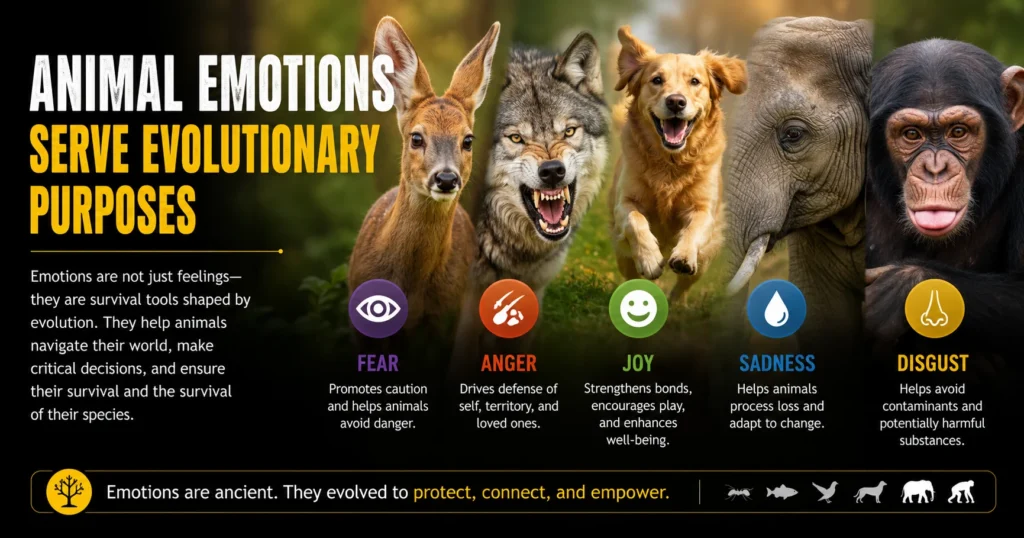
Fear kicks in before thought, helping escape danger faster than logic allows. Joy draws others close, building bonds that last beyond a single moment.
Fear
Fear promotes avoidance of danger.
Affection
Affection strengthens social bonds.
Empathy
Empathy breeds cooperation.
Happiness
Good feelings promote good behavior.
Facing change over time, feelings guide creatures through tricky surroundings. A survival edge often hides in how beings respond emotionally. Moving through uncertainty, moods shape choices just as much as instincts do.
Animals Recall Feelings From Past Events
Emotion and memory are closely connected.
Animals often remember experiences associated with strong emotions.
Positive Memories
Animals remember:
- Food sources
- Friendly individuals
- Safe locations
- Negative Memories
Animals also remember:
- Predators
- Painful events
- Dangerous environments
Later choices often grow from old moments that stick around. Survival plans shift because of what happened before.
Scientists Observe How Animals Feel
Fur-covered creatures offer no words about inner states, so scientists turn to many ways of looking closer. A range of tools fills the silence where speech should be.
Behavioral Observation
Scientists monitor:
- Social interactions
- Play behavior
- Grooming
- Aggression
- Vocalizations
What hides beneath can show up in repetition. Emotional tones slip through familiar rhythms.
Hormone Analysis
Researchers measure hormones such as:
- Cortisol
- Oxytocin
- Dopamine
- Serotonin
When hormones shift, feelings usually follow close behind.
Brain Imaging
Fine details of brain function during feelings come into view through today’s scanning tools. While machines capture signals, researchers track shifts tied to mood. As images form, patterns show where emotion lights up the mind. With each scan, clues emerge about how nerves respond when emotions run high. Though invisible to the eye, electrical whispers reveal inner reactions clearly now.
Cognitive Testing
Figuring out how feelings shape choices drives scientists to study judgment alongside thinking through tough situations.
Myths People Believe About How Animals Feel
Animals Rely on More than Just Instinct
Animals figure things out, adapt when needed – choices come naturally to them. Emotions show up clearly, even without words guiding their actions. What they do shifts with experience, revealing minds at work behind quiet eyes.
Myth Two Mammals Not Alone With Feelings
Birds might feel things. Fish could have emotions too. Some spineless creatures perhaps do as well. What we see hints at inner lives in these animals.
Myth 3 Animal Emotions Work Just Like Ours
Reality: Animal emotions may differ in complexity and expression while serving similar biological functions.
Emotional Animals Can Still Be Rational
Faster choices come when feelings guide them, nudging creatures toward chances or away from danger. A gut sense sharpens reactions without waiting for logic to catch up. Instinctive pulls often point living things where they need to go. Quick inner shifts prepare bodies before thoughts can form. Survival leans on these surges more than cold analysis ever could.
Emotional Intelligence in the Animal Kingdom
Feeling what others feel begins with noticing it first. One step further means making sense of why that emotion shows up. Reacting in a fitting way comes only after those pieces fall into place.
Years passed before anyone questioned if only people could feel deeply. Lately, fresh studies have started to disagree.
Surprising how some creatures handle feelings so well. Take group behavior – often full of quiet understanding. Not just reacting, but sensing what others go through. Connection shows up in subtle gestures, not grand displays. Even silence speaks volumes among certain species.
Understanding Emotional Awareness?
Emotional intelligence includes:
- Recognizing emotions
- Responding to social cues
- Building relationships
- Managing conflict
- Demonstrating empathy
Living together in tight groups pushes some animals to understand feelings better. When creatures share close bonds, reading emotions becomes more useful. Some species get sharper at sensing moods because they rely on each other. Being around others constantly means mistakes in communication can cause problems. So, those who pick up on subtle cues tend to fit in well. Over time, handling emotions smoothly helps them survive alongside peers.
Animals That Show Feelings
Researchers frequently highlight:
- Elephants
- Dolphins
- Chimpanzees
- Bonobos
- Orcas
- Dogs
Certain bird species
Out here, feelings help creatures handle tangled group dynamics. How they react shapes who sticks close, who keeps distance. Living together means reading moods, not just rules. One wrong move can shift alliances fast. Trust builds slowly through repeated moments. Missteps? They’re remembered longer than kindness sometimes. Survival links tightly to understanding others’ hidden tensions.
The way animals show emotions
Feelings animals express to each other, or to themselves, or to us, are not the same as any of the feelings shared between humans.
The recognition of these signals also allows us to have more information about the behavior of the subjects while carrying out the tests.
Body Language
Posture is used to convey messages in the animal world, from dogs and cats to horses.
Examples include:
Dogs
- Wagging tails
- Relaxed posture
- Play bows
- Raised hackles
Cats
- Tail positioning
- Ear movement
- Eye contact
- Arching the back
Horses
- Ear orientation
- Facial tension
- Head position
- Tail movement
Body language often provides immediate clues about emotional states.
Vocal Communication
Animals also express emotions through sound.
Examples include:
- Bird songs
- Dog barks
- Dolphin whistles
- Elephant rumbles
- Whale calls
Different vocalizations can communicate:
- Excitement
- Fear
- Distress
- Attraction
- Social bonding
Facial Expressions
Scientists have identified facial expressions associated with pain and emotions in several species.
Research involving:
- Horses
- Dogs
- Sheep
- Primates
shows that facial changes often reflect emotional experiences.
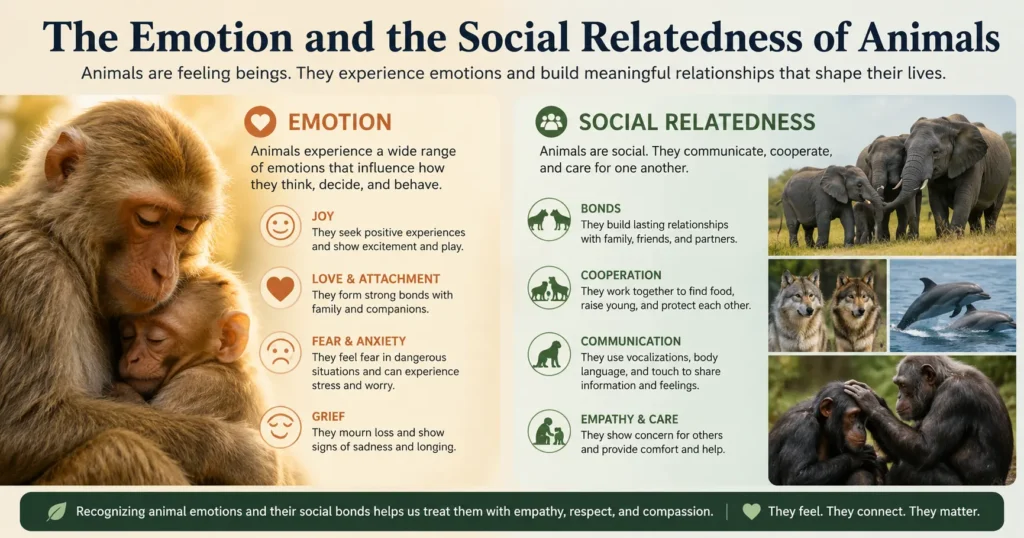
The emotion and the social relatedness of animals
Social animals depend on survival relations.
Emotions are important to keep those ties going.
Friendship in Animals
Researchers have documented friendships in:
- Chimpanzees
- Dolphins
- Horses
- Elephants
- Ravens
Friends often:
- Spend time together
- Groom one another
- Cooperate during challenges
- Provide social support
Cooperation and Trust
Do animals need trust?
Emotional bonding enhances coordination in such activities as:
- Hunting
- Raising offspring
- Defending territory
- Avoiding predators
Social success often depends on emotional relationships.
Animal Sentience versus Species Conservation
Conservationists are coming to understand that mental health matters.
Keeping creatures safe isn’t just about bodies staying alive.
Researchers now consider:
- Social structures
- Family groups
- Emotional health
- Behavioral needs
The Importance of Mental Health
What happens is that when animals are subjected to chronic stress, they often have difficulty:
- Reproduce
- Learn
- Adapt
- Thrive
Conservation programs increasingly focus on preserving natural social environments.
Habitat Protection
Protecting habitats preserves:
- Family relationships
- Social networks
- Natural behaviors
Life in damaged environments may unravel bonds shaped by ages of quiet change. Deep ties, formed long before human memory, face sudden strain when homes disappear. What once grew slowly under steady skies now falters in scattered patches. Hidden threads connecting creatures fray without warning. Old rhythms weaken where forests shrink or rivers stall. Connections built across lifetimes blur in broken landscapes.
How Being Held Affects Feelings
Some creatures find captivity hard, others less so – it hinges on their kind, surroundings, one factor quietly shaping another. How they’re handled shifts things too, like a slow hand turning a dial behind the scenes.
Positive Aspects
A space that runs smoothly could offer:
- Veterinary care
- Protection from predators
- Reliable food supplies
- Environmental enrichment
- Potential Challenges
Captive animals sometimes experience:
- Boredom
- Social isolation
- Frustration
- Chronic stress
These days, zoos, along with wildlife refuges, add playful tasks to help animals feel better inside. Not just cages – moments of surprise appear through hidden food or moving toys. Feelings matter more now when caring for creatures behind fences. Little changes, like puzzles at feeding time, spark curiosity instead of boredom. Emotions get attention thanks to smarter daily routines.
How Surroundings Affect Mood and Mind
Stuff that keeps animals busy, both thinking and moving around, is what environmental enrichment means.
Types of Enrichment
Physical Enrichment
- Climbing structures
- Toys
- Puzzle feeders
Social Enrichment
- Group housing
- Social interactions
- Cooperative activities
Cognitive Enrichment
- Problem-solving tasks
- Training exercises
- Exploration opportunities
When animals have things to do, they worry less and act more like they would in the wild.
Animal Feelings and Right Wrong
More signs point to animals feeling emotions – this shifts how we think about right and wrong. A deeper look changes what we owe them morally.
Felt pain in creatures means people must act more carefully. How they behave shifts when lives beside them matter just as much.
Considerations of ethics
Important questions include:
- How should animals be treated?
- How much attention should they get?
- How can unnecessary suffering be minimized?
These discussions influence:
Agriculture
- Wildlife management
- Research practices
- Pet ownership
Improving Animal Welfare
Modern welfare standards emphasize:
- Physical health conditions.
- Psychological well-being
- Freedom from unnecessary suffering
- Opportunities for natural behavior
Feeling seen can make care feel less cold.
The Emotional Lives Of Farm Animals
Pigs sigh when they’re disappointed. Chickens make worried noises if their chicks seem unsafe. Sheep remember past kindnesses, reacting gently later on. Cows form close bonds and bellow quietly when separated. Horses twitch their ears forward when curious about a new person. Goats stare longer at friends who’ve helped them before.
Pigs
Research shows pigs possess:
- Strong social skills
- Ability to Problem Solve
- Emotional Reaction
Among farm animals, pigs stand out by recalling faces and past encounters with others.
Cows
Besides grazing together, cows bond closely – noticeable tension shows if their favorite partners are taken away. Friendship matters more than we think. Little ones often stay close when mom moves through tall grass. Sometimes they freeze if a shadow passes overhead.
Chickens
Studies suggest chickens experience:
- Fear
- Anticipation
- Social preferences
When baby chickens seem upset, mother hens react right away. Farmers began rethinking care practices after these results showed up. Because of what was learned, treatment standards started shifting slowly across fields where animals are raised.
Marine Mammals Show Deep Emotions
Floating through ocean depths, whales show feelings as deep as their habitat. A dolphin’s joy might ripple across waves in its own quiet way. Even seals, barking on rocky shores, carry more than sound – they carry sentiment. Emotion runs strong beneath fur and flipper alike.
Orcas
Family bonds among orcas can last forever, with pods sticking close through generations. These marine mammals travel in units where ties rarely break, shaped by long years of shared living. Together always, they swim, hunt, feed – linked by deep connections passed down line after line.
Researchers have documented:
- Cooperative hunting
- Grief-like behavior
- Protective caregiving
- Social learning
Whales
Out in the ocean, some whales stick close to certain companions for years. Their ways of talking include layered sounds that carry across vast distances.
From time to time, certain animals act in ways pointing to grief or deep bonds between individuals.
Dolphins
Dolphins continue to provide evidence of advanced emotional intelligence through:
- Play
- Cooperation
- Empathy
- Friendship
Few land animals match how deeply these creatures connect socially.
Do Animals Experience Love?
Even so, some creatures bond tightly, despite disagreements among researchers about labels.
Biological Basis
Love-like bonds involve hormones such as:
- Oxytocin
- Dopamine
- Vasopressin
These chemicals support:
- Pair bonding
- Parenting
- Social attachment
Evidence Across Species
Examples include:
- Prairie voles
- Swans
- Wolves
- Gibbons
- Penguins
Nearly all of these animals remain paired for years, cooperating as partners in numerous aspects.
Animal Emotions and Evolution
What makes feelings stick around? That puzzle sits at the heart of science’s big queries. Why did nature keep them through time? Their survival hints at deeper roots than we first thought.
Evolutionary Advantages
Emotions help animals:
- Avoid danger
- Find mates
- Care for offspring
- Build alliances
Learn from experience
Fear kicking in before thought probably helped creatures stick around long enough to pass on genes. Emotions weren’t just noise – they shaped who made it through tough moments.
Shared Evolutionary History
Common ancestors are shared between humans and animals.
Deep feelings in today’s animals might carry traces of long, slow change across ages. Because of this, we see how people and animals react to feelings in much the same way.
Future Research on Animal Emotions
Scientists continue making new discoveries.
Future studies may explore:
- Consciousness
- Emotional awareness
- Complex social cognition
- Emotional communication
- Brain activity during emotional experiences
Advanced technology is providing unprecedented insight into animal minds.
The next decade could dramatically expand our understanding of animal emotions.
External Links
- National Geographic Animals
- Animal Behavior Society
- World Animal Protection
- Humane Society International
- Smithsonian National Zoo & Conservation Biology Institute
Internal Links
- Understanding Snapping Turtles
- Why Venomous Animals Are Important for Conservation
- How Communities Can Protect Wildlife Habitats
- Animal Intelligence and Survival Strategies
- Endangered Species Conservation Guide
Conclusion
Surprising findings now show creatures feel more than we thought. From birds to mammals, inner experiences like sorrow or connection pop up again and again. Fear shows itself in flight. Joy appears during play. Some even mourn their lost companions. Bonds between individuals run deep, shaped by moments big and small. Empathy isn’t rare – it surfaces quietly, across species.
Surprising behaviors emerge when elephants stand quietly near fallen relatives. Meanwhile, dolphins nudge weakened pod mates toward safety, hinting at deeper bonds than once believed. Old myths fade each time slightly as scientists observe such moments unfold in nature. A shift grows – not loud, but steady – toward seeing animals less like machines and more like beings who feel.
Life feels different when you see animals as emotional beings. Science moves forward because of it. Conservation gains a clearer purpose through such insight. Welfare grows more thoughtful, shaped by what creatures reveal about their inner worlds. Choices around ethics find firmer ground. Respect for life deepens, quietly, without fanfare. The planet seems fuller somehow, shared with beings who experience it in ways we’re only beginning to grasp.
Even with so much still unknown, it’s starting to look certain – feelings aren’t just for people. Linked across life on Earth, they form a quiet thread tying us to animals of every kind.
Studying how animals feel opens a quiet window into forests, oceans, and corners of our own minds. Noticing their joy or fear changes what we assume about life that breathes differently than us.
FAQs
Q1. Do animals really have emotions?
Fear shows up in deer when coyotes are near. Joy jumps through the dogs at playtime. Affection sticks between elephants who touch trunks daily. Stress builds in caged birds over weeks. Social bonds tie primates in shared grooming rituals. Research backs each sign seen across species.
Q2. What creatures display feelings most clearly?
Big brains aren’t always the clue – elephants show deep memory through actions. Dolphins solve problems in ways that surprise careful watchers. Whales form bonds lasting decades without saying a word. Dogs react to human feelings like few others do. Cats notice small shifts in routine that most miss. Chimpanzees pass knowledge across generations slowly. Bonobos settle conflicts with touch instead of force. Some birds craft tools while ignoring shortcuts.
Q3. Can animals feel sadness?
After losing a companion or young, some creatures act in ways that look like sorrow. A bird may sit still for hours when its mate vanishes. Others stop eating or wander without direction after death nearby. Grief seems to ripple through herds when one falls. Even fish have been seen lingering near lifeless bodies. Moments of quiet follow loss among elephants. When a pup dies, wolf packs grow unusually silent. These signs appear across species more often than once believed.
Q4. Do animals cry emotional tears?
While people cry when upset, many creatures show discomfort differently – through sounds or actions instead. Tears that come from feeling are rare beyond our species.
Q5. Can animals love humans?
From birds to pets like horses, deep connections grow between people and creatures such as cats. Dogs often attach closely to those who care for them every day. Creatures, including parrots, build lasting ties through daily moments shared. Horses, too, show quiet loyalty when raised by gentle hands.
Q6. Do animals understand death?
Death seems acknowledged by certain animals when others of their kind pass, yet how they grasp it isn’t like how people do. Their reactions shift around lifeless peers, even if the meaning behind it stays unclear. Not all creatures process loss the way humans claim to; still, signs show awareness lingers in quiet behaviors. A different mindset shows up near dead members – curious pauses, odd sounds, movements that halt. While thoughts remain hidden, responses suggest something deeper than instinct alone.
Q7. Do fish feel things? Maybe they do.
Fish might feel fear, studies now hint more often. Stress shows up in their behavior too, recent work notes. Social choices appear among them; evidence slowly reveals.
Q8. Why are animal emotions important?
Animal emotions matter. They shape not only how we treat them in captivity, and the conservation of their habitats in the wild, but also how we consider moral questions — and even how we connect across species.
Q9. Do animals experience the same feelings as humans?
On the contrary. Though emotional setups look alike across species, creatures might feel things in their own way. Expressions can differ too, shaped by how each one lives.
Q10. Which creature shows the deepest emotional awareness?
Surprisingly wise, elephants show deep feelings when facing loss. Dolphins form tight bonds through years of shared moments. Great apes react strongly to unfairness around them. Cetaceans like orcas grieve their young in ways we’re only beginning to understand.