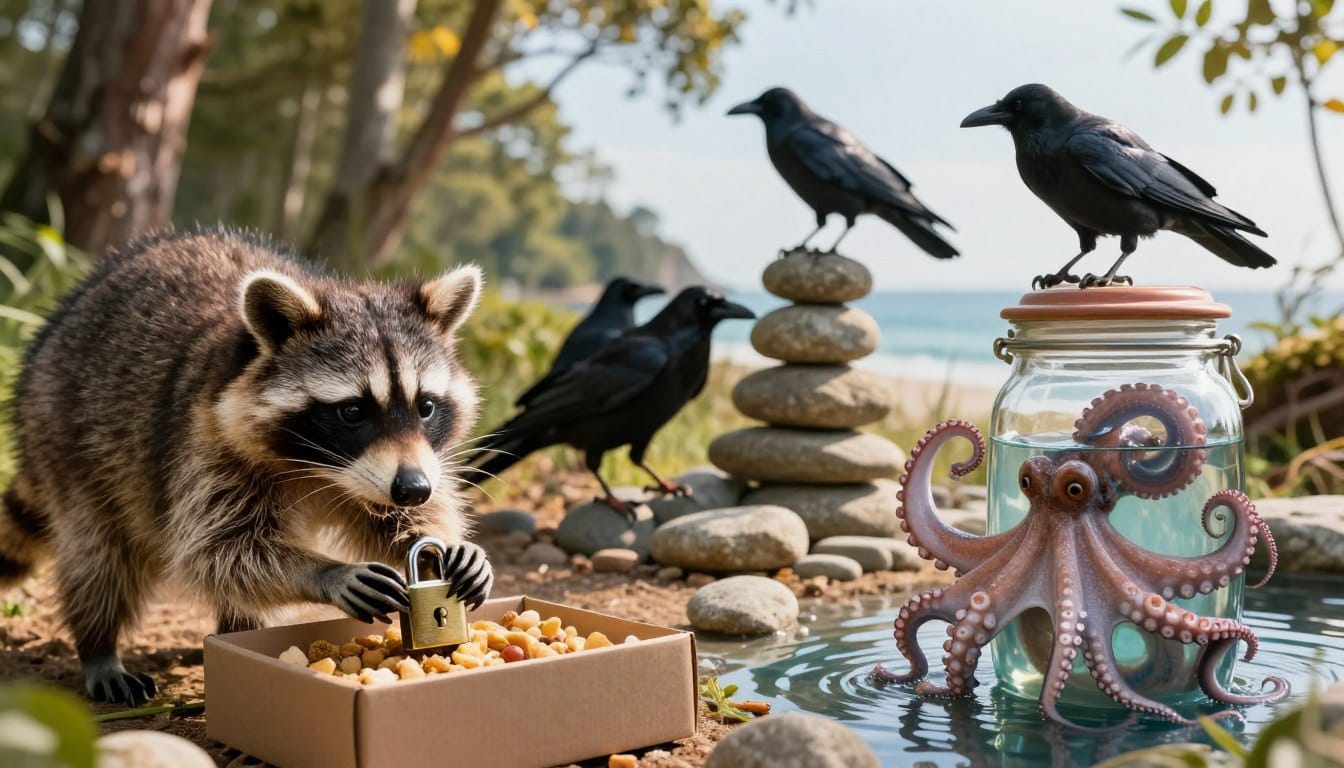
Are animals smarter than humans? You might be surprised to learn that some animal species show intelligence comparable to humans in certain ways. Research in animal cognition reveals that many animals can solve complex problems, communicate effectively, and display social behaviors within their groups. From tool use to memory and cooperation, these abilities highlight that intelligence exists in different forms across species. While humans excel in reasoning and advanced thinking, animals demonstrate unique skills that help them survive and thrive in their environments.
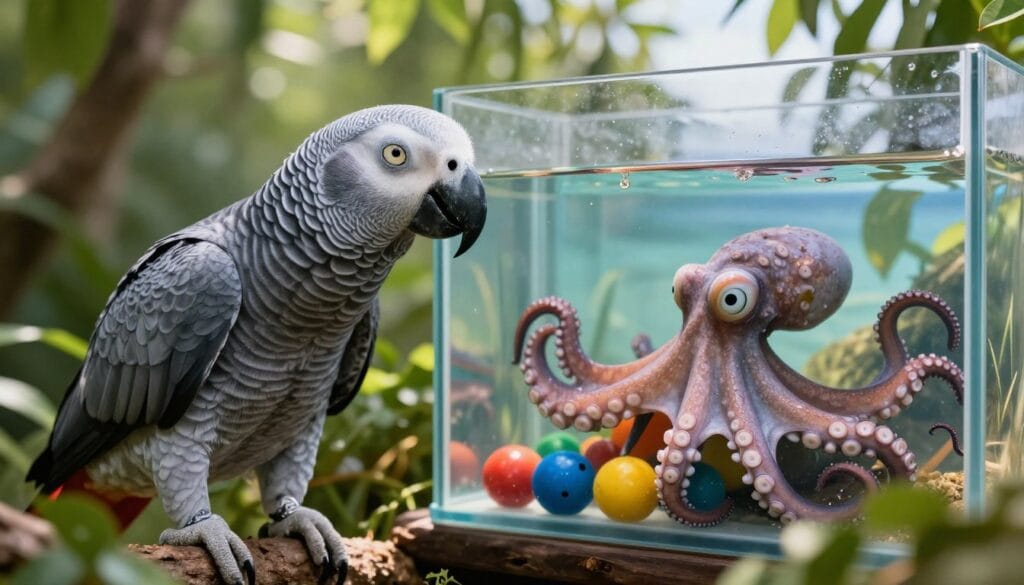
Frans de Waal, a famous primatologist, says animal intelligence is complex. It shows up in different ways than human smarts. As we dive into the world of human vs animal intelligence, you’ll find insights that shake up what we thought we knew.
Key Takeaways
- Understanding animal cognition can provide insights into their behavior.
- Some animal species exhibit complex problem-solving abilities.
- The comparison between human and animal intelligence reveals surprising similarities and differences.
- Animal intelligence is multifaceted and can be observed in various forms.
- Studying animal behavior science can help us better understand their intelligence.
The Intelligence Spectrum: Redefining What “Smart” Really Means
Intelligence is complex and not just for humans. Many animals show unique thinking skills. Our usual ways to measure smarts don’t fully show what animals can do.
Different Types of Intelligence Across Species
Each species has its own kind of smarts. Some animals are great at solving problems. Others remember things very well.
Specialized Intelligence vs. General Intelligence
Some animals are super good at certain things, like finding their way or remembering stuff. General smarts let some animals handle many situations.
Environmental Adaptation as Intelligence
Being smart means adapting to your surroundings. Many animals change how they act to fit their environment. This shows a kind of smarts we often miss.
Why IQ Isn’t the Only Measure of Cognitive Ability
IQ scores don’t tell the whole story. They’re made for humans and don’t show all animal smarts. This is true for animal intelligence, too.
The Limitations of Human-Centric Intelligence Tests
Tests made for humans don’t work for animals. They miss the unique ways animals think. So, these tests don’t really get how smart animals are.
Multiple Intelligence Theory Applied to Animals
The idea of many kinds of smarts works for animals, too. It helps us see that different animals are good at different things. This gives us a better understanding of animal brains.
Animals Are Smarter Than Humans? 5 Cases That Might Convince You
Corvids, like crows, ravens, and jays, are smarter than many think. They solve problems and innovate like primates. Their smartness challenges what we thought about animal brains.
Corvids and Their Remarkable Problem-Solving Abilities
Frans de Waal, a famous scientist, talks about corvids’ smarts. He points out their amazing problem-solving skills. For example, the New Caledonian crow makes tools to get food from trees.
The raven is also very smart. It plans for the future, as humans do. It caches food, showing it can think ahead.
Tool Use and Innovation
Corvids are top tool users in nature. They come up with new ways to use tools. Crows use rocks to open shells, showing their creative problem-solving.
Studying corvids shows us that being smart isn’t just for humans. These birds show us that there are many kinds of intelligence in the world.
Memory Champions of the Animal Kingdom
The animal kingdom is full of amazing memory champions. These animals have incredible memory skills. They can even do better than humans in some tasks.
Chimpanzees’ Photographic Memory Capabilities
Chimpanzees are smart and have great memory. They can remember pictures very well. This skill helps them a lot.
The Ayumu Study: Outperforming Humans in Memory Tests
A chimpanzee named Ayumu beat humans in memory tests. He could remember numbers shown on a screen very well. This was even when the numbers were up for just a short time.
Short-Term Memory Superiority
Ayumu showed how good chimpanzees are at remembering things for a short time. This skill is very useful for them. It helps them make quick decisions to stay alive.
Clark’s Nutcrackers and Their Thousands of Food Caches
Clark’s nutcrackers are birds with amazing memories. They can remember where they hid food. They can find food months later.
How Sea Lions Never Forget a Face
Sea lions are also very good at remembering faces. They can tell faces apart. This is important for their social life.
These animals show us how different and amazing memory can be. By studying them, we learn more about their brains and how they behave.
Problem-Solving Prodigies: When Animals Outsmart Humans
Some animals are smarter than humans in solving problems. The animal world is full of clever creatures. They often outsmart us in different ways.
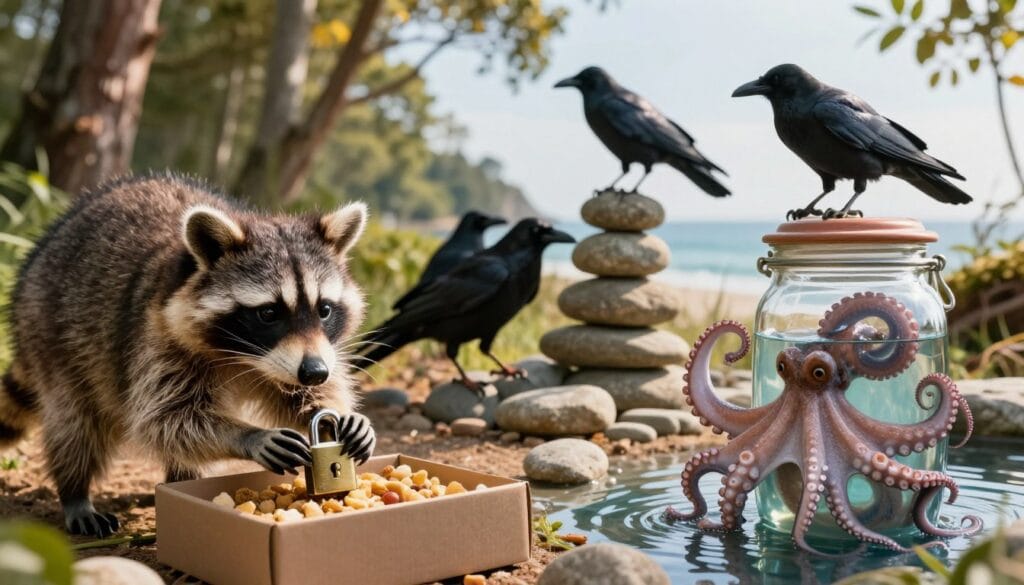
Crows Creating Tools for Specific Tasks
Crows are very smart. They make tools for specific jobs. They use sticks to get grubs and rocks to crack nuts.
Orangutans and Their Mechanical Comprehension
Orangutans understand mechanical things well. They use tools in a smart way. This shows they really get how things work.
Using Hammers and Levers in the Wild
In the wild, orangutans use hammers and levers. They use these tools to get what they need. This shows their smart use of mechanical knowledge.
Mimicking Human Actions Without Training
Orangutans can act like humans without learning. This shows their advanced thinking skills. It’s really impressive.
Dolphins’ Innovative Hunting Techniques
Dolphins have cool hunting ways. They use sponges to protect their noses while hunting. This shows their creative problem-solving.
| Animal | Problem-Solving Ability | Example |
| Crows | Tool creation | Using sticks to dig up grubs |
| Orangutans | Mechanical comprehension | Using hammers and levers |
| Dolphins | Innovative hunting | Using sponges while foraging |
These examples show how smart animals can be. They challenge the idea that humans are the smartest.
Communication Complexities: Beyond Human Language
Exploring animal communication shows us how complex it can be. Animals use many ways to share info, warn others, and pass on culture. These methods are not just cool but also show how smart and social different animals are.
Prairie Dogs’ Sophisticated Alarm Calls
Prairie dogs have a special alarm call system. It helps them tell about predators in detail. This is key for their survival.
Describing Predators in Detail
Studies show prairie dogs can tell about a predator’s type, size, and color. This is amazing and shows they think deeply.
The “Language” Debate Among Researchers
Experts disagree whether prairie dogs’ calls are a language. While it’s different from ours, it shares some traits.
Whales and Their Cultural Song Transmission
Whales are famous for their songs. These songs are part of a tradition passed down. It shows their complex social lives.
Bees’ Dance Language: Conveying Complex Directions
Honeybees use dance to tell where food is. Their dance tells about direction, distance, and food quality. It’s very detailed.
| Species | Communication Method | Information Conveyed |
| Prairie Dogs | Advanced Alarm Calls | Predator Type, Size, Color |
| Whales | Cultural Song Transmission | Cultural Knowledge, Social Identity |
| Bees | Dance Language | Food Source Direction, Distance, Quality |
These examples show how animals communicate in many ways. They share important info for survival and social life.
Survival Intelligence: Instincts That Humans Have Lost
When you explore nature, you see animals with instincts we’ve lost. These instincts help them survive and amaze us. For example, migratory birds have an internal GPS that guides them on long journeys.
Migratory Birds’ Internal GPS Systems. Migratory birds travel long distances without getting lost. They use their internal GPS systems to navigate. This system is influenced by the Earth’s magnetic field, the sun, and stars.

Anticipating Natural Disasters: How Animals Sense Danger
Many animals can anticipate natural disasters like tsunamis and storms. They sense these dangers through their keen senses.
Elephants Detecting Tsunamis
Elephants can feel the low-frequency rumblings of a tsunami. This lets them move to safer places.
Toads Predicting Earthquakes
Toads often leave their breeding sites before an earthquake. They seem to sense the danger coming.
Adaptation Skills That Outpace Human Evolution
Animals have adaptation skills that help them survive in many environments. These skills often improve faster than ours.
Learning from animals’ resilience can teach us a lot. By studying their survival tactics, we can appreciate nature more.
Social Intelligence: The Complexity of Animal Communities
Exploring animal social intelligence shows us complex communities like human societies. Many animals have advanced social behaviors. They work together, communicate, and solve problems.
These social structures show animals’ adaptability and intelligence. Wolves and ants have unique strategies to survive and grow.
Wolves and Their Sophisticated Pack Dynamics
Wolves are a great example of animal social intelligence. Their packs have a clear order and roles. This helps them hunt big prey together.
Ants’ Collective Problem-Solving Abilities
Ants also show social intelligence. Their colonies work together to solve problems.
Building Living Bridges and Rafts
Some ants build living bridges and rafts. They link their bodies to cross hard places and find food.
Farming and Livestock Management
Some ants farm fungus for food. They manage complex societies. This is rare in animals.
Elephants’ Multi-Generational Social Structures
Elephants live in complex, multi-generational groups. Older females lead and share their knowledge. They guide their herds through tough times.
| Species | Social Structure | Notable Behaviors |
| Wolves | Hierarchical packs | Coordinated hunting |
| Ants | Colonies with division of labor | Living bridges, agriculture |
| Elephants | Multi-generational herds | Matriarchal leadership |
These examples show the variety and complexity of animal social intelligence. By studying them, we learn more about animal communities.
Learning From Animal Intelligence: What It Means For Human Evolution
Studying animal intelligence shows us a complex world. It has a big impact on our society. As we learn about animal thinking, we find new ways to innovate and face big questions about right and wrong.
Animal smarts inspire us to create new things. This is called biomimicry. By looking at how animals adapt, we make new tech and solve big problems.
Biomimicry: How Animal Intelligence Inspires Human Innovation
Biomimicry has brought us many new ideas. For example, studying how insects work together has helped us make robots that can work on their own.
| Animal Intelligence | Biomimicry Application |
| Swarm intelligence in insects | Decentralized robotics systems |
| Migratory patterns of birds | Efficient navigation systems |
| Web-building strategies of spiders | Advanced materials and structures |
The Ethical Implications of Recognizing Advanced Animal Cognition
When we see how smart animals are, we must think differently about them. This makes us question how we treat animals. It’s about animal welfare, saving species, and how we do research.
Understanding animal thoughts and feelings helps us live better with nature. We can be kinder and more caring towards all living things.
Conclusion: Redefining the Human-Animal Intelligence Relationship
Exploring animal intelligence shows us that humans are not always the smartest. Many species can solve problems, remember, and talk to each other. This proves that being intelligent is not just for humans.
We should think differently about how smart animals are compared to us. Intelligence is not just one thing. It’s a range of skills found in many species. By seeing intelligence in a new light, we can understand the world better.
This new view of animal smarts changes how we treat them. We need to be kinder and more respectful to animals. Recognizing our connection with them is key to a better future.
FAQ‘s
What is animal intelligence, and how is it measured?
Animal intelligence is about how smart animals are. It includes solving problems, remembering things, and talking to each other. Scientists study this by watching animals, doing experiments, and comparing them to humans.
Are animals smarter than humans in certain areas?
Yes, some animals are way smarter than us in certain things. They can remember stuff better, solve problems faster, and talk in their own ways.
Page 5: What are some examples of animals that exhibit advanced cognitive abilities?
Chimpanzees, crows, octopuses, dolphins, and elephants are very smart. They can solve complex problems, remember a lot, and talk in their own ways.
How do animals adapt to their environments, and what does this say about their intelligence?
Animals change to fit their surroundings in many ways. They migrate, hibernate, and change their behavior. This shows they are smart and can handle new situations.
What is biomimicry, and how does it relate to animal intelligence?
Biomimicry is using nature and animal tricks to make new things. It shows how smart animals are and helps us solve problems in new ways.
What are the ethical implications of recognizing advanced animal cognition?
Knowing animals are smart makes us think about how we treat them. We need to rethink how we care for animals in places like zoos, farms, and research labs.
How does understanding animal intelligence impact Page 10: our understanding of human intelligence?
Learning about animal smarts makes us see human smarts in a new light. It shows that intelligence is not just one thing, but many different kinds that animals and humans both have.
What is the multiple intelligences theory, and how does it apply to animals?
The multiple intelligences theory says there are many kinds of smarts, not just one. This idea helps us see how animals are smart in their own ways, showing their unique talents.