
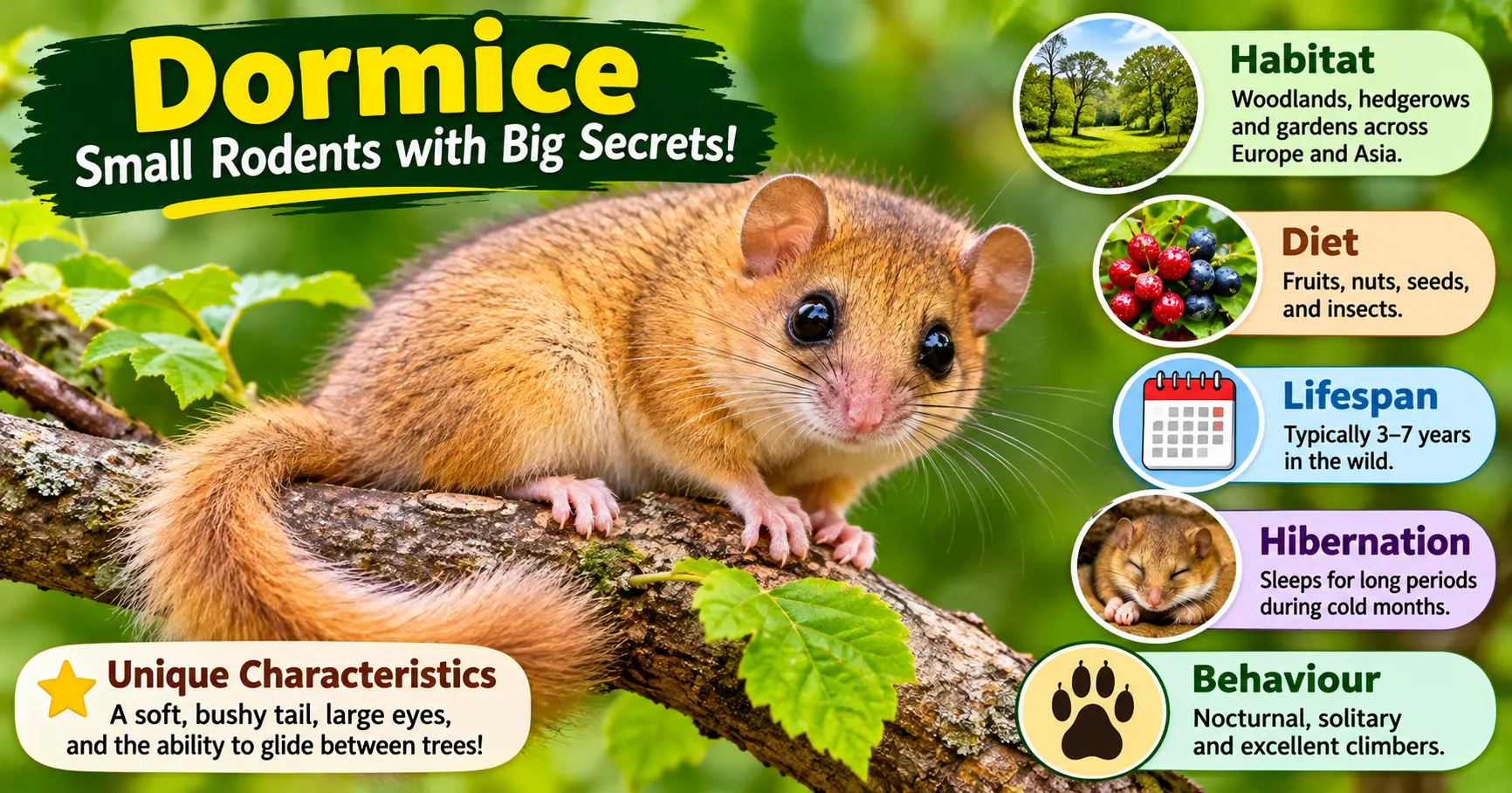
You can recognize dormice by their large eyes, furry tails, nighttime activity, and use of sheltered nests. They are mostly nocturnal, so sightings may last only a moment. Look for several signs in a garden or near trees, rather than relying on one quick glimpse. Their habitats and habits can change with the season, including summer activity. Torpor is a short-term energy-saving state in which an animal lowers its body temperature and activity. Knowing this can help you understand why an animal may seem still. Large eyes and a furry tail are useful clues, but they do not identify a species by themselves.
Focus on visible signs and the setting where you spot them. A single clue is not enough to identify a species, so look for several signs together.

Key Takeaways
- Look for large eyes and a furry tail.
- Most dormice are active at night.
- A few clues are better together.
- Torpor is a short-term energy-saving state.
- Observe from a distance and leave nests alone.
How Can You Identify Dormice?
A dormouse has a furry tail and belongs to a different rodent family than a true mouse. Dormice belong to Gliridae, while true mice belong to Muridae; both are rodents in the order Rodentia. Their small bodies, soft fur, large eyes, rounded ears, and short legs give many species a similar look.
Most species climb well and are active at night. A bushy or hairy tail is another useful clue, though the tail’s shape and coat color vary.
Furred tails, eyes, and climbing
The body and tail can help you tell a dormouse from other small rodents. Dormice range from 6 to 19 centimeters in body length and 15 to 180 grams in weight. These broad ranges reflect differences among species.
Large eyes suit their nighttime habits, while short legs and nimble feet help many species climb. Some tails look bushy, while others appear less full. A tail covered in fur is a stronger family clue than color alone.
True mice and dormice are both rodents, but their family names differ. That difference matters when you compare species or look up a reliable animal name.
European edible dormouse and smaller look-alikes
I see the European edible dormouse in the search name; the largest example is used in this comparison. Its head and body measure 14 to 19 centimeters, followed by an 11 to 13-centimeter tail. It can weigh up to 180 grams.
The hazel dormouse is much smaller. It has a body length of 6 to 9 centimeters, a 5.7 to 6.8-centimeter tail, and weighs 15 to 40 grams. The African pygmy dormouse averages about 25 grams and about 15 centimeters in total length.
The African pygmy dormouse (Char Dorsum Rhinomy, often just known as the African dormouse, African dwarf dormouse, woodland dormouse, or micro squirrel. European edible dormouse measurements give you a useful size comparison with smaller species.
| Common name | Measurements as stated | Adult weight | Identification clue |
|---|---|---|---|
| Hazel dormouse | 6-9 cm body; 5.7-6.8 cm tail | 15-40 g | Golden-brown fur and large black eyes |
| European edible dormouse | 14-19 cm head-body; 11-13 cm tail | Up to 180 g | Largest dormouse example |
| African pygmy dormouse | About 15 cm total length | About 25 g | Also called the micro squirrel |
Treat coat color alone as a weak clue because color varies among species.
Where Do Dormice Live and Nest?
A dormouse may live in a forest canopy, a rocky crevice, or a sheltered burrow, depending on its species. Dormice occupy habitats across Africa, Asia, and Europe, and many species spend much of their time in trees. The family includes nine genera and 28 living species.
Forests and orchards are common settings, but dormice also use scrub, rocky places, and deserts. Some live in savannahs, gardens, or farmland. This range means that a sighting does not always point to a woodland habitat.
The Animal Diversity Web account of Gliridae describes the family’s broad range and varied habitats. Many species are arboreal, which means they live or move among trees.
Nests can be in trees or bushes, but also in rock crevices, burrows, and spaces among tree roots. Some species use abandoned bird or squirrel nests. A nest site may be on the ground, not in a tree.
These sheltered spots can be hard to notice. Look for signs of an animal’s use of an area without moving leaves, branches, or other cover. A hidden nest may blend into its surroundings.
The hazel dormouse favors connected woodland, shrubs, and hedgerows. These links between trees and bushes help it move through its habitat. In Britain, hazel dormice are mainly found in southern England and Wales.
Building nests from grass and leaves: Pascal’s Hotel. Their nests can hold litters of up to seven young. That makes an occupied nest especially easy to disturb if you inspect it too closely.
Other species use a wider mix of places, from forest settings to dry, rocky ground. A single family member’s habits do not describe every dormouse. The habitat and choice of nest differ with species and environmental variables.
Some animals may use a nest site for a short time, while others return to sheltered places. You may find signs in a tree, a hedge, or at ground level. No one nest shape or location fits the whole family.
In a garden, shrubs and connected tree cover can offer suitable shelter for some species. A rocky edge or a burrow may matter more in a different setting. Keep any observation focused on the animal, not on opening its shelter.
If you find a nest, watch from a distance and leave it undisturbed.

What Do Dormice Eat and When Are They Active?
Most dormice feed at night, and their food choices change with the season. Their diet can include fruit, berries, flowers, nuts, insects, and other small prey. Temperate dormice may hibernate for six months or longer.
Dormice are mostly nocturnal, so you may miss their feeding even where food remains show activity. Their diet shifts as different foods become available. They consume plant matter as well as hunted prey.
Nighttime feeding through the growing season
Flowers, fruits, and nuts supply plant food, while insects and other small prey add variety. Dormice lack a cecum, a gut pouch many rodents use to ferment plant matter. Their feeding habits reflect this difference in digestion.
Seasonal foods may include:
- Spring flowers
- Summer insects
- Autumn fruit
- Autumn nuts
Food choice can change through the year as blooms fade and fruit or nuts ripen. The list shows a broad pattern, not a fixed menu for every species.
Autumn preparation for winter
Before hibernation, dormice build up body fat for the long period without regular feeding. That reserve helps them survive while their activity falls. Some species may wake briefly during winter.
European edible dormice are active for roughly six months and may hibernate from about October to May. Local climate can shift that timing. Their winter sleep can take up much of the year.
Hibernation, torpor, and unusually long dormancy
Hibernation lasts longer than torpor, which is a shorter energy-saving state. Tropical or desert species may use torpor instead of long winter hibernation. Records of edible dormouse hibernation include wild animals asleep for more than 11 months straight.
Edible dormice that skip reproduction may enter estivation, a summer dormancy, in early summer. They can then remain below ground through hibernation for almost one year. This unusual pattern links summer dormancy with the following winter period.
Leave a winter nest alone, since waking a hibernating animal can use energy reserves.

How Do Dormice Interact With People?
The edible dormouse has been eaten as a delicacy, but its place in human life differs by region. People eat edible dormice in parts of Europe, while ownership rules in the United States can vary by state and locality. Squirrels: Two times used as exotic pets.
The European edible dormouse’s common name reflects its history as food. Ancient Romans raised the animals in gliraria, special enclosures for raising dormice for the table.
Edible dormice on the table
Edible dormouse meat is rich and greasy, with only a few mouthfuls of meat per animal. Roman gliraria and edible dormouse dishes reflect a long food tradition. Romans raised them for the table.
In Croatia, people grill edible dormice over an open flame and serve them on bread. In Slovenia, cooks may bake them with buckwheat or prepare them in goulash or stew. These dishes are regional, not common across all of Europe.
So, are dormice, including the edible dormouse, eaten? Yes, some parts of Europe do eat edible dormice. Their place on the menu depends on regional food customs.
Pet ownership and U.S. rules
Dormice are rare exotic pets for some, though Americans keep them as foils in the; U.S. ownership rules differ. Every state has laws that allow, restrict, or prohibit ownership of certain exotic animals. Local restrictions may apply, too.
A dormouse for sale in the United States may be subject to state and local rules. Check these points before you consider buying one:
- State wildlife rules
- Local restrictions
- Exact species identification
- Whether the animal is legally available
These checks matter because a common name can cover more than one species. The exact animal and your location can affect which rules apply.
When an edible dormouse becomes a pest
Is the edible dormouse a pest? It can be a pest in parts of Britain where it is non-native, but that status does not apply everywhere. Non-native edible dormice were introduced to Britain in 1908 and live in woods around Tring, Hertfordshire.
In that area, they may enter houses and damage trees. This local issue should not be treated as a trait of every dormouse or every place. Hazel dormouse numbers in Britain declined 70% between 2000 and 2022, a separate conservation concern.
Treat a wild dormouse sighting as a reason to protect its habitat, not to collect it.

Conclusion
The most useful dormouse clue is a combination of features, behavior, and habitat. One sign alone can mislead you, since species and local conditions differ. Changes in range over the years can also shape where you may see them.
Note the location and habitat when you spot one, without disturbing the animal or its shelter. Record what you saw and where you saw it, then share the observation with a local conservation organization.
FAQ
How long does a dormouse sleep?
Temperate dormice can hibernate for six months or longer. Some edible dormice have been recorded hibernating for more than 11 months straight. Hibernation length depends on species and climate. During this time, dormice lower activity and rely on stored body fat, so waking one can use energy it needs to survive.
What is a micro squirrel?
A micro squirrel is another name for the African pygmy dormouse, Graphiurus murinus. The animal is also called the woodland dormouse. Other common names include African dormouse and African dwarf dormouse. These names refer to the same species, not to a squirrel in the true squirrel family.
What is the difference between dormice and mice?
Dormice belong to Gliridae, while true mice belong to Muridae. Both families belong to the order Rodentia. Their shared order means they are related, but they are not the same family. A furry tail and large eyes can help you spot dormice, though those features alone do not prove identity.
Do people eat edible dormice?
Yes, people eat edible dormice in parts of Croatia and Slovenia. In Croatia, they may grill the animals over an open flame and serve them on bread. In Slovenia, cooks may bake them with buckwheat or add them to goulash or stew. These dishes are tied to regional food traditions.
Are dormices kept as pets?
Yes, some dormice are kept as exotic pets. U.S. state laws may allow, restrict, or prohibit ownership of certain exotic animals, and local limits can apply too. The exact species matters when you check the rules. A seller’s offer does not by itself mean that keeping the animal is legal.
What does dormouse taste like?
Edible dormouse meat is described as rich and greasy. Each animal provides only a few mouthfuls of meat. People in parts of Europe prepare it in different ways, including grilling, baking with buckwheat, or cooking it in a stew. The taste description refers to the edible dormouse, not every dormouse species.
Are there dormice in America?
Dormice are naturally found in Africa, Asia, and Europe, not in the Americas. A dormouse you see for sale in the United States would not be native wildlife. Rules for owning such an exotic animal can differ by state and town, so the species name and location both matter.
Why did Romans eat dormice?
Romans treated edible dormice as a delicacy and raised them in gliraria for the table. These enclosures were used to keep and raise the animals for food. The European edible dormouse’s common name reflects this food history. The Roman custom does not mean dormice were eaten everywhere or remain a common food today.