
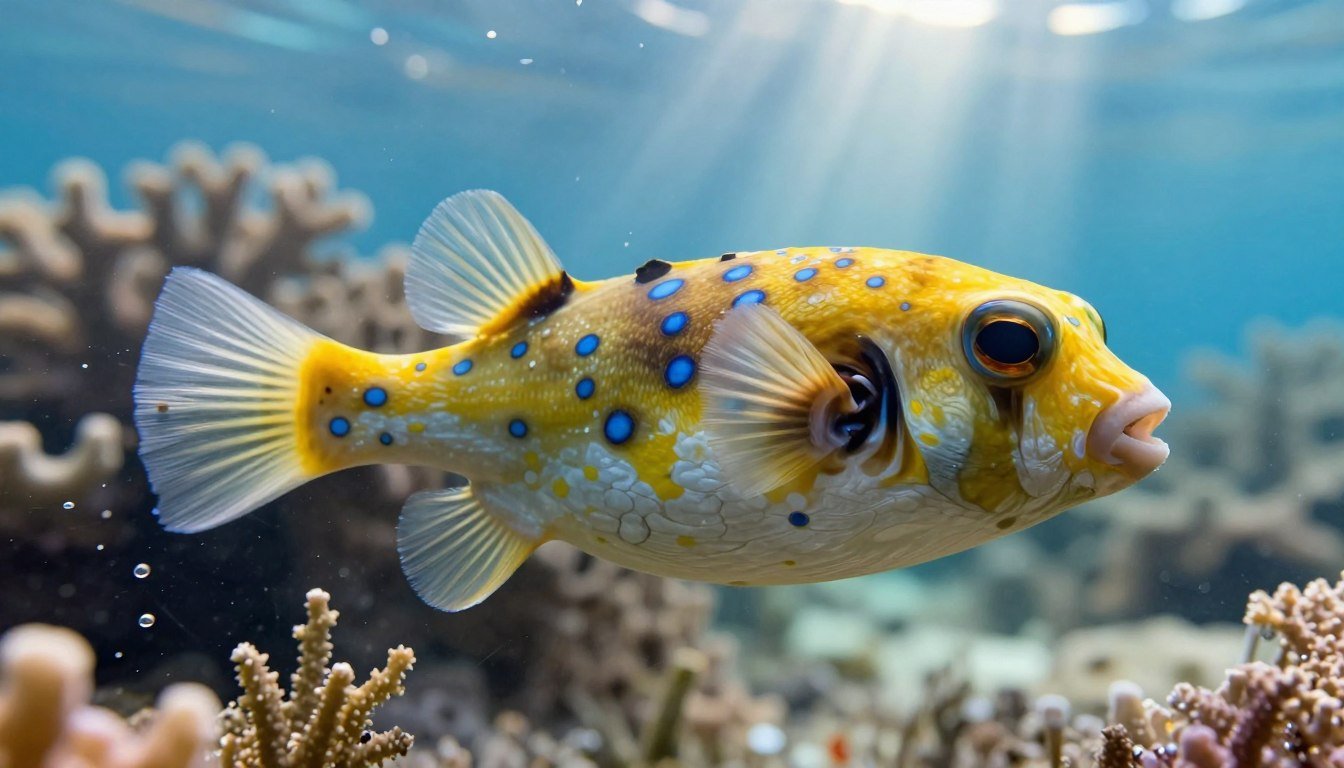
You can identify unusual ocean pufferfish most reliably by combining body shape, color pattern, fin and spine placement, and habitat, not by inflation alone. One species has been recorded from just one collected specimen, a reminder that a striking sighting and a rare record are different things.
An unusual look alone does not prove a fish is rare. You may see a fish briefly, at a distance, or in water that makes its colors hard to read. Compare several visible clues before you settle on a name.
Good notes help you separate what you saw from what you think it means. Record the shape, pattern, fins, spines, and setting, including whether the fish was near a reef or in open water. Those details can make later checks more useful than memory alone.
Color can help, but light and viewing angle may change how it appears. If you enjoy comparing marine patterns, see this guide to another colorful marine animal. Write down what you observed before assigning a species name.
Key Takeaways
- Use several clues together.
- Note habitat and water depth.
- Do not judge rarity by looks.
- Keep uncertain names provisional.
- Write down what you observed.
How Do Pufferfish Differ from Porcupinefish?
A pufferfish has a fused four-tooth beak and small skin spines, while a porcupinefish is distinguished by longer external spines. The two fish can look alike, especially when their spines lie flat.
Check the beak and spine type, not inflation alone. Pufferfish belong to Tetraodontidae, a family with 196 species. Porcupinefish belong to the separate Diodontidae family.
The fused beak and reduced fins
Pufferfish have four beak-like teeth, formed from fused teeth in the upper and lower jaws. They generally lack pelvic fins, which sit on the underside of many other fish.
Pufferfish have no scales, and their colors range from bright to muted. Habitat and diet partly shape those colors, so color alone can mislead you.
Their small dermal spines form in the skin and may stay hidden while the fish is deflated. Dermal spines are small spines formed in the skin that may be hidden while a pufferfish is deflated.
The Seattle Aquarium explains the fused beak and spine differences between these fish. That comparison can help when a distant view hides smaller details.
Skin spines versus long external spines
Porcupinefish carry long external spines that lie flat when deflated and stand erect when inflated. Their raised spines create a clear outline that differs from the pufferfish’s smaller skin spines.
Inflation can make either fish appear larger, but it does not replace the other clues. Look for the shape of the mouth, the fin positions, and whether the spines appear long and separate from the skin.
Fin placement also matters because pufferfish generally lack pelvic fins. If prominent pelvic fins appear to be the main clue, recheck the identification rather than assuming the fish is a pufferfish.
Rare Ocean Pufferfish: Which Species Stand Out?
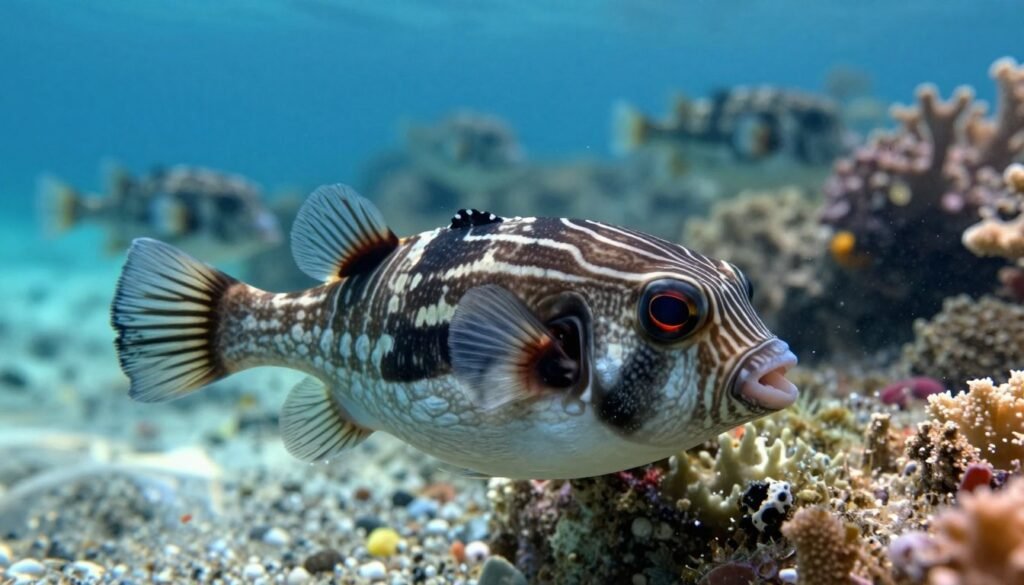
A striped toby is a standout because its 12-14 dark body stripes identify it, while its collection record is exceptionally limited. It was described as a new species in 2012 from one specimen collected in French Polynesia’s Gambier Archipelago. No additional individuals had been collected when the Smithsonian account appeared.
Use each species’ pattern and habitat together. The map puffer, Arothron mappa, has a maze-like pattern, unlike the striped toby’s straight lines. You can also compare how color patterns mark another marine animal.
| Name | Identifying clue | Habitat |
|---|---|---|
| Striped toby | 12-14 dark body stripes; one specimen recorded | Gambier Archipelago, French Polynesia |
| Smooth pufferfish | Adults offshore; juveniles closer to shore | Atlantic |
| Oceanic puffer | Elongated body, gray-blue back, spotted silver sides, white belly, rear fin, underside spines | Tropical and subtropical waters worldwide, near surface to 3000 feet |
| Spotted porcupinefish | Adults often about 1.5 feet; can reach nearly 3 feet | Reefs, caves, and rocky shelter in tropical and subtropical seas |
Smooth pufferfish adults live offshore in the Atlantic water column, while juveniles occur closer to shore. Oceanic puffers may grow to 2 feet and weigh 7.5 pounds. Do not apply a reef species’ habitat to an open-water sighting.
How Can You Confirm a Rare Pufferfish Sighting?
A single unusual-looking fish can suggest a rare species, but one sighting alone cannot establish how rare that species is. A collection record counts specimens collected, not all fish living in the wild.
Unusual behavior also needs context. Some pufferfish make ornate round sand nests as mating displays, but a nest alone cannot identify a species. Coffinfish are not pufferfish, despite the similar-sounding name.
A rare record is not a population count
Pufferfish include both marine and freshwater species. Some live in freshwater rivers in Southeast Asia, South America, and Africa, so a river setting does not rule out every pufferfish.
Inflation is a defense, not a display to request. Pufferfish can inflate to nearly three times their ordinary size, so never chase or provoke one to see it puff up.
The blackspotted puffer occurs in the Pacific and Indian oceans and is poisonous, so it is not safe to eat. A fish’s appearance cannot tell you whether it is safe as food.
Observe without handling or provoking the fish
Use these checks to keep your identification grounded in what you can see:
- Compare a clear photo with an authoritative species guide.
- Check whether the habitat matches the candidate species.
- Record the date and exact location.
- Keep an uncertain identification provisional.
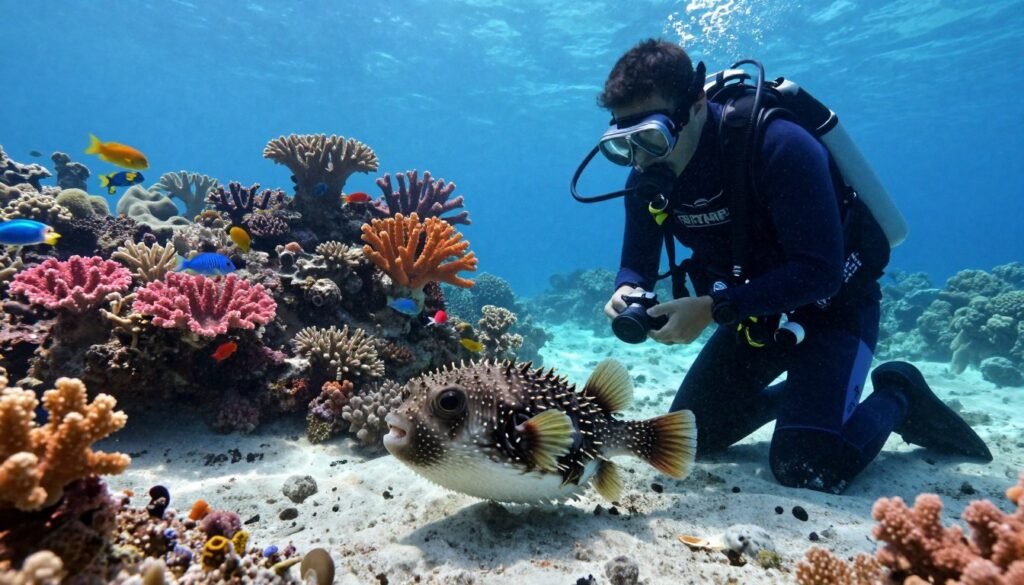
Take a picture from a safe distance, with the full body and fins in view. Do not handle the fish or push it into a defensive response for a better image.
Make your notes useful to someone checking the sighting later. Keep the scientific name separate from the common name in your field notes.
Conclusion
A reliable identification comes from matching more than one visible feature to the fish’s habitat. Body shape, color, fins, and the setting each add a piece of evidence.
Keep your first guess open to change, especially when a photo hides key details. A fish seen in shallow water may look different from one seen offshore, and distance can blur its pattern.
Once you have a candidate, check its scientific name against a regional fish field guide. A regional guide can help you judge whether that species fits the waters where you saw it. Use the scientific name to check your candidate against a regional fish field guide.
FAQ
What does a limited collection record tell you about a species’ rarity?
A limited collection record tells you how many specimens people have collected, not how many fish live in the wild. Collecting may cover only certain places or times, so a small record does not prove that a species is scarce. Treat the record as evidence about what has been found, not a count of the whole population.
Do all pufferfish live in salt water?
No, some pufferfish live in freshwater rivers, including in Southeast Asia, South America, and Africa. Pufferfish also live in marine waters, so the family spans very different habitats. When you identify one, use its location and water type as clues, then compare those details with the species’ known range.
Can you judge whether a pufferfish is safe to eat by looking at it?
No, appearance does not establish whether a pufferfish is safe to eat. The blackspotted puffer is poisonous and occurs in the Pacific and Indian oceans. A photo or color pattern cannot show food safety, so do not use looks as a test. Identification and food safety are separate questions.
What should you include in a photo of an unfamiliar pufferfish?
Capture the full body profile, visible pattern, and fins from a safe distance. Keep enough of the surrounding water in the frame to show whether the fish is near a reef or in open water. Do not chase, handle, or provoke the fish to improve the shot, since inflation is a defense.
Why do some pufferfish make circles in the sand?
Some pufferfish make ornate round sand nests as mating displays. The shape can make the nest striking, but it does not identify the fish or prove that the species is rare. A clear view of the fish’s body, pattern, and habitat gives you better clues than the nest by itself.
Can a pufferfish be identified by color alone?
No, color alone is not enough to identify a pufferfish. Match its colors and pattern with its body shape, fin placement, and habitat. Color can shift from bright to muted with factors such as habitat and diet, while water and viewing angle can make a pattern harder to read.