
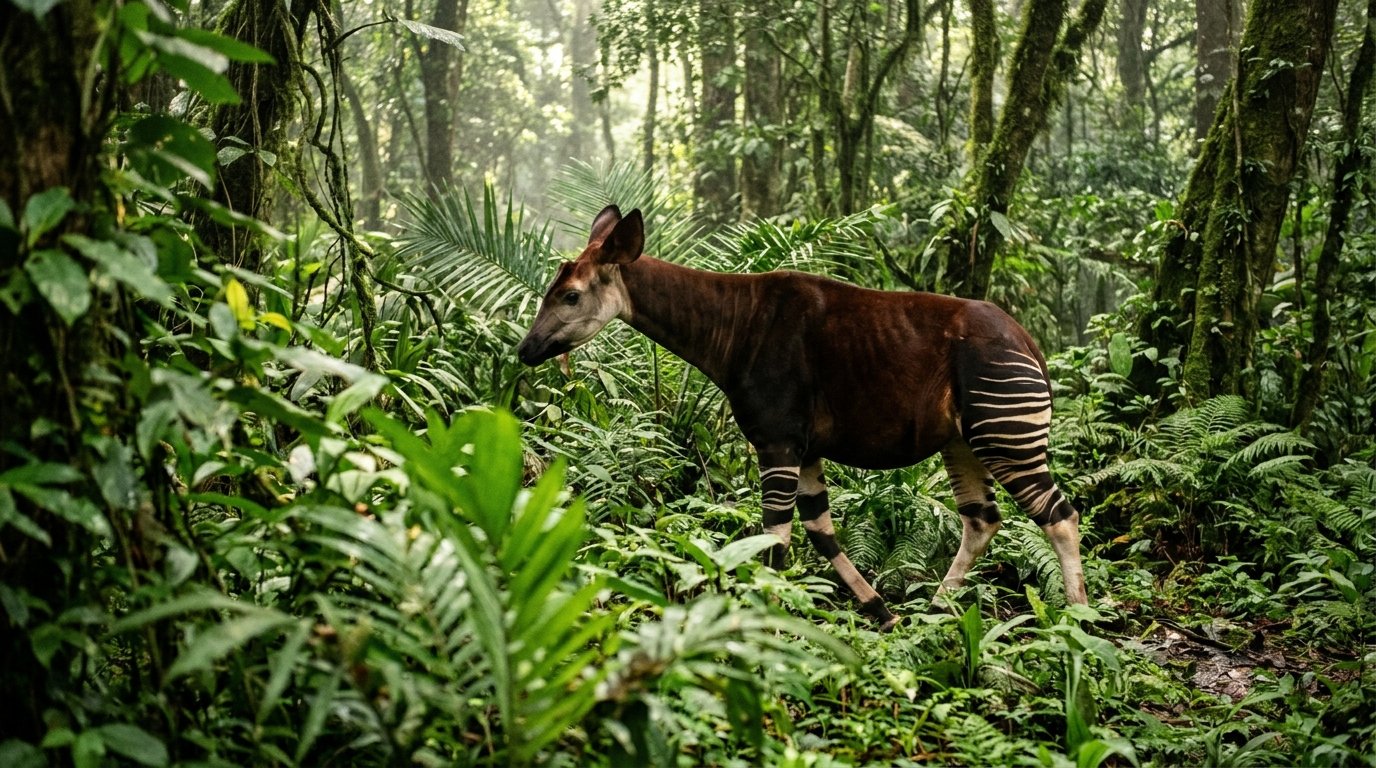
Imagine spotting a brown animal with striped legs moving between trees, and trying to work out what you are seeing. This forest animal lives in the Democratic Republic of the Congo, far from most people’s daily lives. Its coat may suggest one familiar animal, while its shape hints at another.
These 20 okapi facts give you clear, useful details about its appearance, habitat, behavior, and survival. You will learn what makes this mammal distinct and why its forest home matters. The striped legs are only one clue to its identity.
Key Takeaways
- The okapi is a distinct mammal, not a zebra-giraffe cross.
- Its striped legs stand out against its dark coat.
- It lives in a limited part of central Africa.
- Its behavior and body hold many forest-ready surprises.
- By the end, you will be able to distinguish the okapi’s unusual traits from the lookalikes its appearance might suggest.
How Can You Tell an Okapi From a Zebra or Giraffe?
An okapi is a giraffid, not a crossbreed, even though its striped legs can make it look part zebra. The okapi and giraffe are the only living members of Giraffidae, the giraffe family. The okapi is most closely related to the giraffe, not the zebra.
Its scientific name is Okapia johnstoni, and it is the only living species in the genus Okapia. Ossicones are short, hair-covered horn-like structures on the heads of male okapis. Zebra-like stripes do not mean the species has zebra ancestry.
The giraffe connection, without the zebra confusion
An okapi may look like a mix of a giraffe and zebra, but that resemblance comes from its coat. A giraffe has spots, while a zebra has bold stripes across much of its body. The okapi’s markings sit mainly on its legs.
| Animal | Family | Relationship to okapi | Markings |
|---|---|---|---|
| Okapi | Giraffidae | Same family; closest living relative is giraffe | White leg stripes and rings; brown coat |
| Giraffe | Giraffidae | Closest living relative | Large patches across coat |
| Zebra | Equidae | Unrelated | Black-and-white stripes across body |
Coat, size, and the male-female difference
The coat ranges from chocolate to reddish brown, with white stripes and rings on the legs and white ankles. An okapi stands about 1.5 m (4 ft 11 in) at the shoulder, has a typical body length of about 2.5 m (8 ft 2 in), and weighs 200-350 kg (440-770 lb).
Male okapis grow ossicones less than 15 cm (5.9 in) long. Female okapis do not have them. To identify a male, look for the small hair-covered ossicones; females do not have them.
What Do These 20 Okapi Facts Tell You About the Forest Mammal?
The okapi’s story reached formal scientific recognition in 1901, but its forest adaptations are just as striking as its history. These 20 okapi facts show how its past, body, and behavior fit life in central Africa. Its closest living relative is the giraffe, and the two share key traits.
How the okapi came to scientific attention
- Okapia johnstoni was formally recognized as a species in 1901.
- The name johnstoni honors Sir Harry Johnston.
- Okapi may come from the Mbuba word okapi or the Lese Karo o’api.
- Johnston obtained striped skin and a skull, but never saw a live okapi.
- A genetic study found the giraffe and okapi ancestor lived about 11.5 million years ago.
Adaptations for moving through the forest
- Okapis and giraffes move the front and hind legs on one side together when they walk.
- Both animals have seven cervical vertebrae, the bones in the neck.
- Stripes can break up an okapi’s outline among dense plants.
- The stripes may help calves follow their mothers in dim forest light.
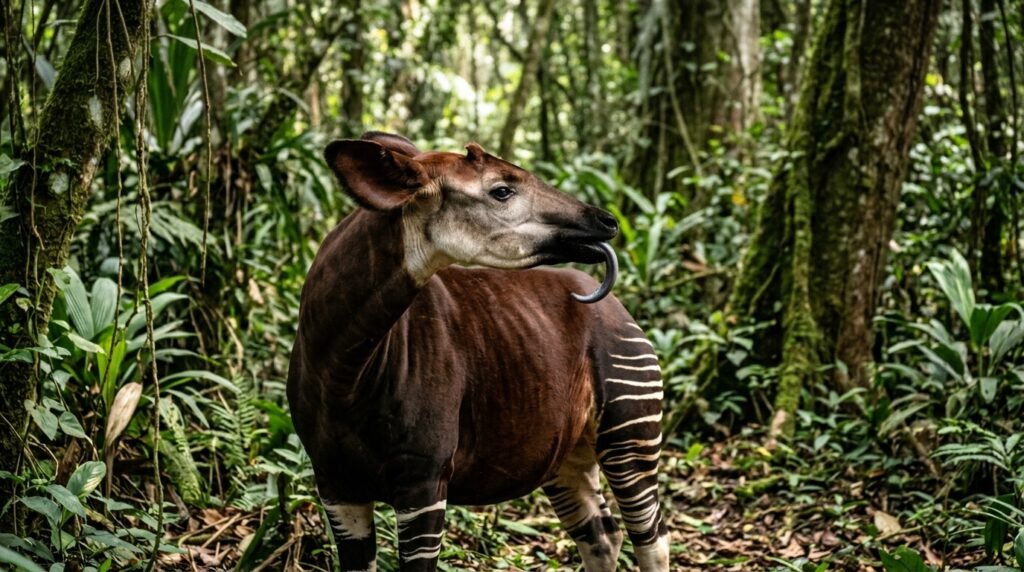
- An okapi’s tongue is 12-14 inches long.
- It can use its tongue to clean its ears and eyelids.
- Its eyesight is poor.
- Its hearing is strong.
Small behaviors that help explain the animal
- Scent glands on its feet leave sticky markings.
- Those foot markings can form scent trails.
- Okapis also mark by urinating and rubbing their necks on trees.
- Their calls include chuffs, moans, and bleats.
- A newborn can stand within 30 minutes.
- Calves may avoid defecating during their first month or two.
- The leopard is the okapi’s main natural predator.
These behaviors help explain how a quiet forest animal moves, marks its space, and stays close to its mother. The calf’s early habits differ from those of many familiar mammals. Its mother’s presence is especially important during that first stretch of life.
The most surprising detail for many people is that this elusive mammal can reach its ears with its own tongue. You can find more animal guides and wildlife stories through Pets News Life.
Where Do Okapis Live, and How Many Remain in the Wild?
In the wild, okapis live only in the northeastern Democratic Republic of the Congo, not across Central Africa as a whole. They inhabit canopy forests at elevations of 500-1,500 m (1,600-4,900 ft). The estimated wild total is 10,000-15,000, but that estimate is about a decade old.
The Okapi Wildlife Reserve lies in the Ituri Forest and covers about one-fifth of it. It is estimated to hold 3,000 okapis, a reserve figure distinct from the nationwide estimate. Both figures are estimates, not a live count.
| Place or measure | Figure | What the figure describes |
|---|---|---|
| Wild range | Northeastern Democratic Republic of the Congo | The okapi’s only wild range |
| Forest elevation | 500-1,500 m (1,600-4,900 ft) | Canopy forest habitat |
| Reserve share | About one-fifth | Share of the Ituri Forest in the Okapi Wildlife Reserve |
| Population estimates | 10,000-15,000 wild; about a decade old; 3,000 in reserve | Nationwide estimate and reserve estimate |
The reserve’s boundaries protect part of the forest where the species lives. It does not represent the full wild range, which lies within the Democratic Republic of the Congo. There is no wild range across the Republic of the Congo.
Treat the nationwide estimate as an aging estimate, not a current headcount.
What Do Okapis Eat, and How Do They Forage?
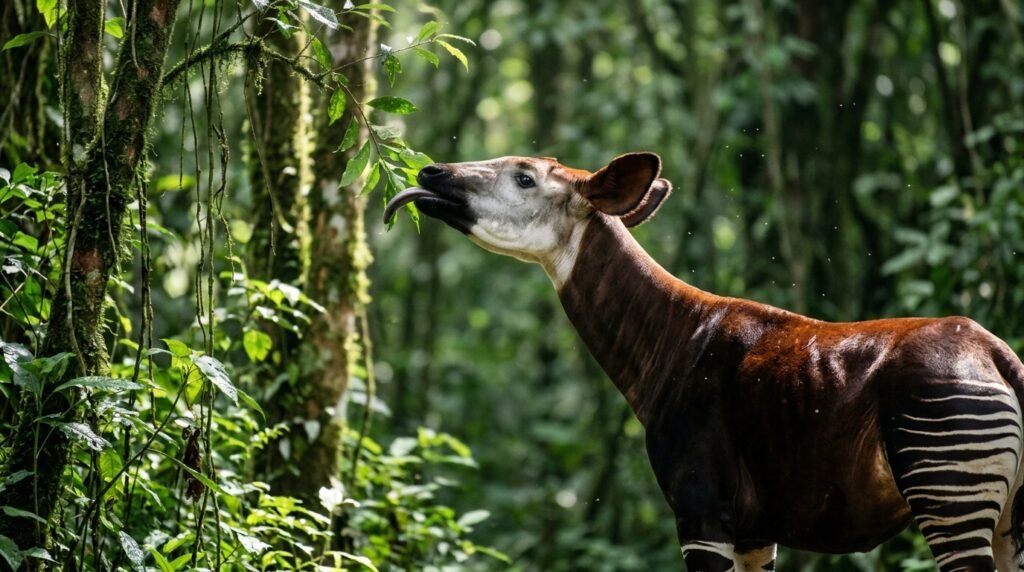
An okapi does not browse indiscriminately: it selects food from a wide range of forest plants. Its diet includes leaves, fruits, seeds, ferns, and fungi from about 100 plant species. It can eat about 45-60 pounds of food a day.
A selective plant-based menu
Okapi diet is mainly plant matter, gathered from many kinds of trees and low plants. The animal uses its prehensile tongue, which can grasp and pull, to strip leaves from branches. Its four-chambered stomach helps break down tough plant material.
Some food sources are less expected. Okapis also take in clay, burnt charcoal, and bat guano found inside hollow trees. These materials add mineral and nutrient sources alongside the plants they eat.
Solitary routines and the long tongue
Okapis are mainly active in daylight, though they may move about for a few hours in darkness. They are essentially solitary and usually come together to breed. Each animal forages on its own through the forest rather than feeding in a group.
Their feeding style suits a habitat where leaves and buds grow at different heights and places. A grasping tongue can pull foliage from branches without the animal needing to break them. A hollow tree can offer more than leaves, since okapis also take in clay, burnt charcoal, and bat guano found inside.
How Do Okapi Calves Grow From Birth to Adulthood?
An okapi’s pregnancy lasts around 440 days, and the usual outcome is one calf. Only one case of twins has been recorded. A newborn calf weighs 14-30 kg (31-66 lb).
The calf grows through several clear stages before reaching adult size. Solid food begins before weaning, and growth continues for years after birth. The table shows the main timeline.
| Stage | Age or duration | Development |
|---|---|---|
| Gestation | Around 440 days | Pregnancy before birth |
| Birth | Newborn | Usually one calf; 14-30 kg (31-66 lb) |
| First solid food and rumination | By week 3; by week 6 | Solid food starts; rumination can be seen |
| Weaning | About 6 months | Most calves stop nursing around this age |
| Adult size | About 3 years | Okapis reach adult size |
Calves may continue suckling after they begin eating solid food. This overlap lets them keep nursing as they grow and learn to feed on their own. Growth to adult size takes longer than the first feeding milestones.
The median life expectancy for okapis in managed care is 17 years. That figure describes animals in managed care, not a wild-life estimate. Some calves may keep suckling for more than a year even though weaning usually occurs at about 6 months.
What Threatens Okapis, and How Are They Protected?
Okapis are Endangered, and protecting them means addressing threats to both the animals and their forest habitat. The IUCN Red List classifies the species as Endangered, and CITES moved it to Appendix I in November 2025, which bans international commercial trade. Logging, settlement, mining, and hunting all put pressure on okapis.
- Logging removes forest cover.
- Human settlement changes forest habitat.
- Illegal mining brings activity into okapi habitat.
- Hunting targets okapis for bushmeat and skins.
The Okapi Conservation Project began in 1987 to help protect habitat in the Ituri Forest. Conservation work can also face direct danger: an attack on a breeding center in 2012 killed six staff members and 14 okapis.
For more about wildlife and endangered-animal care, visit Pets News Life’s mission. The Okapi Conservation Project’s work began in 1987, but protection still depends on keeping habitat and conservation work secure.
Related Reading on Pets News Life
- Bonobos Animal: The Peaceful Ape That Mirrors Humanity, another rare animal from the Congo Basin
- Endangered Deer Species: Conservation Efforts and Challenges
- Asian Elephant Linh Mai: 7 Inspiring Facts and Her Story
External Resources
- Okapi Conservation Project: The Okapi
- Fauna & Flora: Highest level of protection for the okapi
- Okapi (Wikipedia)
Conclusion
The okapi’s unusual appearance is only one part of what makes it remarkable. Its zebra-like markings do not make it related to zebras; it is a distinct member of Giraffidae. Its future depends on protecting the forest where it lives.
You can learn more about the Ituri Forest and the Okapi Conservation Project through reputable conservation and natural-history organizations. Look for groups that explain their habitat work and share clear details about the wildlife they protect. To deepen your understanding, explore how protecting the Ituri Forest supports the okapi and other wildlife that share its home.
FAQ
Are Okapia mixed breed?
No, Okapia is a distinct species in the giraffe family, not a hybrid of a zebra and giraffe. Its scientific name is Okapia johnstoni, and it is the only living species in its genus. The stripes on its legs can make it look zebra-like, but markings do not show close family ties. Its closest living relative is the giraffe.
How fast can okapi run?
A reported top speed for an okapi is 60 kph (37 mph). That is a high speed for a forest animal, though it does not mean an okapi runs that fast all day. Dense vegetation can limit how far it moves in a straight line. Its long legs and strong body help it move through forest terrain.
How many okapi are in the wild?
The estimated wild population is 10,000-15,000, but that estimate is about a decade old. It should not be treated as a current headcount. Around 3,000 are estimated to live in the Okapi Wildlife Reserve, which is only part of the species’ wild range. The okapi lives only in the northeastern Democratic Republic of the Congo.
What is a interesting fact about okapi?
One striking fact is that an okapi has a 12-14-inch prehensile tongue. It can pull leaves from branches and clean its ears and eyelids with it. The tongue helps the animal reach food and groom parts of its body that would otherwise be hard to reach. Its use for both tasks makes it especially unusual.
Can okapi have babies?
Yes, female okapis can have calves, and pregnancy lasts around 440 days. They usually give birth to one calf, and only one case of twins has been recorded. A newborn can stand within 30 minutes. The calf starts eating solid food by its third week, while rumination can be seen by its sixth week.
Is Okapia unicorn?
No, Okapia is the genus name for the okapi, not a unicorn. The species’ scientific name is Okapia johnstoni. Male okapis have short, hair-covered ossicones, which can look horn-like, while females lack them. Those small structures are not a sign that the animal belongs to a mythical species.
Can an okapi swim?
Yes, an okapi can swim when necessary, but it is a land-dwelling forest mammal rather than an aquatic forager. Its daily life centers on moving through forest habitat and finding plant food. Swimming is not a regular part of its feeding routine. The species is adapted to life on land beneath the forest canopy.
Do okapi have teeth?
Yes, okapis have teeth that help them eat plant material. Their low-crowned, finely cusped teeth cut tender foliage. These teeth work with a four-chambered stomach, which helps digest tough plant matter. Together, these features support a diet drawn from many kinds of forest plants rather than meat.